
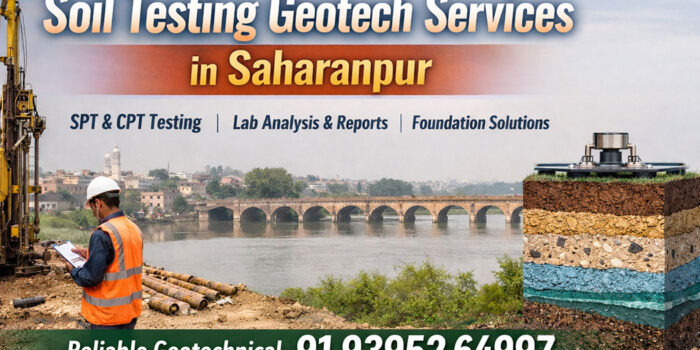
Soil Testing Geotech Services in Saharanpur, Uttar Pradesh by Dibru Enterprises Overseas Infrastructure development, building…
Soil Testing Geotech Services in Gorakhpur, Uttar Pradesh

Soil Testing Geotech Services in Gorakhpur, Uttar Pradesh by Dibru Enterprises Overseas
Modern construction projects demand accurate information about ground conditions before structural design begins. Soil behavior varies greatly from location to location, and the stability of a structure largely depends on the characteristics of the soil beneath it. For this reason, soil investigation and geotechnical analysis form the foundation of safe and efficient infrastructure development.
Dibru Enterprises Overseas, based in Guwahati, Assam, provides professional Soil Testing Geotech Services in Gorakhpur, Uttar Pradesh and across India. The company delivers reliable soil investigation, geotechnical testing, and engineering analysis for residential buildings, industrial facilities, highways, bridges, and infrastructure projects.
Clients benefit from scientifically conducted soil testing, modern equipment, and experienced geotechnical professionals. Reliable data from these investigations helps engineers design safe foundations and optimize construction costs.
Phone: 91 93952 64997
Email: dibru.ent@gmail.com
Website: https://dibruenterprises.com/
Understanding Soil Testing Geotech Services
Soil Testing Geotech Services refer to technical procedures that evaluate the physical, mechanical, and chemical properties of soil and underlying geological formations. These services support civil engineering and construction projects by determining whether the soil conditions can safely support proposed structures.
Every building, bridge, or infrastructure system transfers its load to the ground. When soil conditions remain unknown or poorly understood, serious risks arise. Structural settlement, foundation cracks, and even catastrophic failures may occur due to unsuitable ground conditions.
Geotechnical investigation provides detailed insight into soil layers, groundwater levels, and soil strength parameters. Engineers use these findings to select appropriate foundation systems and construction methods.
Dibru Enterprises Overseas performs comprehensive soil testing services that provide accurate data for design engineers and project planners.
Importance of Soil Testing for Construction Projects
Construction projects require a deep understanding of ground behavior before excavation begins. Soil testing ensures that project planning aligns with actual site conditions.
Several critical benefits arise from professional geotechnical investigations.
Risk Reduction
Subsurface conditions often vary significantly even within a small geographic area. Soil testing identifies weak layers, soft clay deposits, loose sand, or high groundwater levels that could cause settlement or instability.
Early identification prevents costly failures during construction or after project completion.
Optimized Structural Design
Accurate soil parameters allow engineers to design foundations with proper load-bearing capacity. Without reliable data, engineers may overdesign foundations, increasing project costs unnecessarily.
On the other hand, underdesign creates serious safety hazards.
Compliance with Building Regulations
Many government authorities require soil investigation reports before issuing construction permits. Certified geotechnical reports help ensure compliance with engineering standards and building codes.
Improved Construction Planning
Soil testing helps determine excavation strategies, compaction requirements, drainage needs, and slope stability measures.
Geographic and Soil Characteristics of Gorakhpur, Uttar Pradesh
Gorakhpur is located in the eastern region of Uttar Pradesh and forms part of the fertile Indo-Gangetic plain. The area lies near the Rapti River and experiences seasonal flooding during monsoon periods.
The geological conditions in Gorakhpur mainly consist of alluvial soil deposits. These soils developed through centuries of river sedimentation and contain mixtures of sand, silt, and clay.
Certain characteristics influence construction activities in this region.
Alluvial Soil Layers
Alluvial soils dominate the terrain in Gorakhpur. These soils typically include layers of silty sand, clay, and fine sand deposited by river systems.
Such soil profiles may exhibit moderate bearing capacity but can also contain compressible clay layers that lead to settlement.
High Groundwater Levels
Many parts of eastern Uttar Pradesh experience relatively shallow groundwater tables. During monsoon months, groundwater levels rise significantly.
Foundation systems must consider these conditions to avoid water-related structural problems.
Flood-Prone Zones
Some parts of Gorakhpur experience periodic flooding due to heavy rainfall and river overflow. Soil investigation becomes essential in such areas to assess drainage behavior and soil stability.
Soft Clay Deposits
Soft clay layers occasionally appear in the region. These soils show lower shear strength and may require ground improvement techniques or deep foundation systems.
Professional soil testing ensures that engineers understand these variations before construction begins.
Core Objectives of Soil Testing Geotech Services
Dibru Enterprises Overseas performs soil investigation with several engineering objectives in mind.
Assess Soil Strength and Stability
Soil strength determines whether the ground can safely support structural loads. Testing identifies bearing capacity, shear resistance, and compaction characteristics.
Engineers rely on this information when selecting foundation types.
Characterize Soil Composition
Soil consists of different particle sizes including sand, silt, and clay. The proportion of these components influences drainage behavior, compressibility, and load-bearing capacity.
Laboratory analysis determines grain size distribution and plasticity properties.
Determine Groundwater Conditions
Groundwater significantly affects foundation stability. Soil testing evaluates the depth and movement of the water table.
High groundwater levels require special foundation design considerations.
Support Foundation Design
Geotechnical data provides essential input for designing shallow foundations, pile foundations, retaining walls, embankments, and other structural elements.
Engineers depend on this data for safe and economical design.
Field Investigations Conducted During Soil Testing
Field investigations form the first step in geotechnical evaluation. These tests measure soil properties directly at the project site.
Standard Penetration Test (SPT)
The Standard Penetration Test is widely used in geotechnical engineering. A split spoon sampler penetrates soil using controlled hammer blows.
The number of blows required for penetration indicates soil density and strength.
SPT results help estimate soil bearing capacity and settlement characteristics.
Cone Penetration Test (CPT)
Cone Penetration Testing provides continuous soil resistance measurements with depth. A cone-shaped probe penetrates soil at a constant rate while sensors measure resistance.
This method produces highly detailed soil profiles.
Plate Load Test
The Plate Load Test evaluates the bearing capacity of soil directly at the construction site. Engineers place a steel plate on the ground and apply incremental loads.
Settlement measurements reveal how soil responds to structural loads.
Laboratory Testing of Soil Samples
After field sampling, soil specimens undergo detailed laboratory testing. These tests determine physical and mechanical properties required for engineering design.
Grain Size Analysis
Grain size analysis determines the percentage of sand, silt, and clay particles in the soil. This information helps classify soil type according to engineering standards.
Particle distribution influences drainage behavior and compaction characteristics.
Atterberg Limits Test
Atterberg Limits evaluate the plasticity and consistency of fine-grained soils. These tests determine the liquid limit, plastic limit, and plasticity index.
Such parameters help engineers assess soil compressibility and expansion potential.
Moisture Content and Density Tests
Moisture content affects soil strength and compaction behavior. Laboratory tests determine natural water content and dry density.
Engineers use this information to design appropriate compaction methods during construction.
Shear Strength Tests
Direct shear tests and triaxial compression tests evaluate soil resistance to sliding forces. These tests determine the shear strength parameters of soil.
Shear strength values support the design of foundations, retaining structures, and slopes.
Geotechnical Reporting and Engineering Recommendations
After completing field and laboratory investigations, engineers prepare a detailed geotechnical report. This report forms a crucial document for project planning and structural design.
A typical geotechnical report includes several components.
Soil Stratification
The report describes the layering of soil beneath the site. Each layer includes depth, thickness, and soil classification.
Engineering Properties
Important parameters such as bearing capacity, shear strength, and compressibility appear in the report.
Groundwater Information
Groundwater levels and seasonal variations receive detailed documentation.
Foundation Recommendations
Engineers recommend suitable foundation systems based on soil characteristics. Options may include shallow footings, raft foundations, or deep pile foundations.
Construction Guidelines
Reports also provide recommendations for excavation methods, soil compaction procedures, and drainage systems.
Applications of Soil Testing Geotech Services
Soil testing plays an essential role in numerous engineering sectors.
Building Construction
Residential and commercial buildings require accurate soil investigation before foundation design begins.
Infrastructure Development
Major infrastructure projects such as highways, bridges, railways, airports, and dams depend heavily on geotechnical data.
Industrial Facilities
Factories and industrial plants often involve heavy machinery and dynamic loads. Soil analysis ensures ground stability under such conditions.
Environmental Engineering Projects
Geotechnical testing helps evaluate soil suitability for landfills, containment systems, and remediation projects.
Slope Stability Analysis
Engineers perform soil investigations to evaluate landslide risks and slope stability for hillside developments and embankments.
Why Choose Dibru Enterprises Overseas for Soil Testing in Gorakhpur
Dibru Enterprises Overseas provides dependable soil testing services with professional expertise and modern equipment.
Several factors distinguish the company in the geotechnical services sector.
Nationwide Service Coverage
The company provides soil testing services across India. Clients from different regions benefit from consistent engineering standards and reliable reporting.
Experienced Technical Team
Qualified engineers and technicians conduct field investigations and laboratory testing using established engineering practices.
Accurate Data and Analysis
Precise measurements and scientific analysis ensure reliable geotechnical reports.
Customized Solutions
Different projects require different approaches. The team analyzes project requirements and site conditions before recommending suitable testing methods.
Reliable Project Support
Construction professionals receive detailed reports and technical guidance throughout the project planning phase.
Contact Dibru Enterprises Overseas
Organizations planning construction projects in Gorakhpur, Uttar Pradesh can rely on professional soil investigation services from Dibru Enterprises Overseas.
Accurate geotechnical data ensures safe design, efficient construction, and long-term structural performance.
Dibru Enterprises Overseas
Guwahati, Assam, India
Phone: 91 93952 64997
Email: dibru.ent@gmail.com
Website: https://dibruenterprises.com/
Conclusion
Soil Testing Geotech Services form the backbone of modern civil engineering and infrastructure development. Reliable soil data prevents structural failures and supports cost-effective design decisions.
Gorakhpur’s alluvial soil conditions, fluctuating groundwater levels, and flood-prone zones make geotechnical investigation especially important for construction projects in the region.
Dibru Enterprises Overseas delivers professional soil testing services with accurate field investigations, laboratory analysis, and comprehensive engineering reports. Builders, developers, and infrastructure planners benefit from dependable geotechnical insights that support safe and durable construction.
For projects in Gorakhpur and throughout India, expert soil testing ensures that every structure begins with a strong and reliable foundation.
Related Posts


This Post Has 0 Comments