
Earth Resistivity Test and Electrical Resistivity Tomography (ERT) for Earth Mat Design in Roing, Arunachal…
Earth Resistivity Test and Electrical Resistivity Tomography (ERT) for Earth Mat Design in Tezu
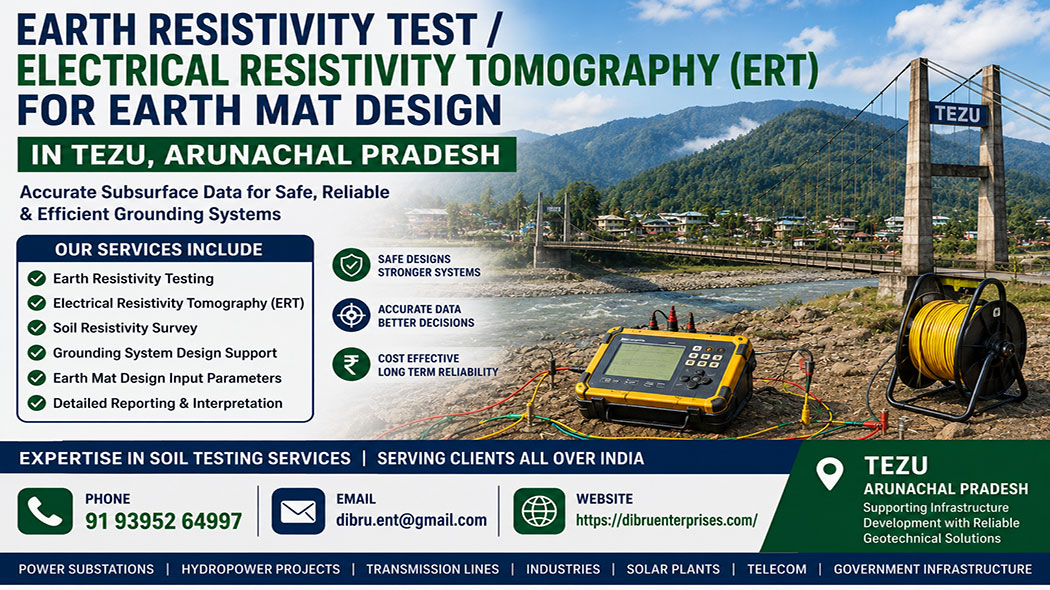
Earth Resistivity Test and Electrical Resistivity Tomography (ERT) for Earth Mat Design in Tezu, Arunachal Pradesh
Electrical grounding is one of the most important components of any power system. Whether the project involves a power substation, transmission line, hydropower facility, industrial plant, solar power installation, telecom tower, or government infrastructure, the effectiveness of the grounding system directly impacts safety, equipment protection, and operational reliability.
A successful earthing system begins with understanding the electrical properties of the soil beneath the project site. This is where Earth Resistivity Testing and Electrical Resistivity Tomography (ERT) become essential. Dibru Enterprises Overseas, based in Guwahati, Assam, offers professional Earth Resistivity Test and ERT services in Tezu, Arunachal Pradesh, and throughout India.
With extensive experience in soil investigation and geophysical surveys, our team provides accurate subsurface data required for efficient earth mat design and grounding system engineering.
Why Earth Resistivity Testing is Essential
Every grounding system depends on the ability of the surrounding soil to conduct electrical current. Soil resistivity measures how strongly the ground resists the flow of electricity.
When an electrical fault occurs, fault current must dissipate safely into the earth. If the soil has high resistivity and the grounding system is poorly designed, dangerous touch voltages and equipment damage may result.
Earth resistivity testing helps engineers determine:
- Soil conductivity characteristics
- Grounding resistance expectations
- Earth mat dimensions
- Electrode requirements
- Conductor sizing
- Safety compliance requirements
- Cost-effective grounding solutions
Accurate soil resistivity data allows engineers to create reliable grounding systems that perform effectively under both normal and fault conditions.
Understanding the Importance of Earth Mat Design
An earth mat, often referred to as a grounding grid, is a network of interconnected conductors installed beneath or around electrical installations.
Its primary functions include:
- Dissipating fault currents safely
- Protecting personnel from electric shock
- Minimizing step and touch voltages
- Protecting transformers and switchgear
- Enhancing lightning protection systems
- Improving operational reliability
Without proper resistivity data, earth mat designs may either be insufficient or unnecessarily expensive.
A detailed resistivity investigation provides the foundation for optimized grounding design.
Tezu: A Unique Environment for Grounding Investigations
Tezu, located in the Lohit district of Arunachal Pradesh, presents a distinct geological and environmental setting compared to many other regions of India.
The town is situated near the Lohit River and surrounded by mountainous terrain, forested landscapes, and varied geological formations. These factors significantly influence soil resistivity characteristics.
Understanding local ground conditions is critical before designing any grounding system.
River Valley Influence
The presence of river systems and alluvial deposits can create zones with relatively low resistivity. However, resistivity values may vary considerably depending on depth and moisture content.
Mountainous Terrain
Many project locations around Tezu are situated in elevated areas or near hill slopes. Ground conditions can change rapidly over short distances.
Mixed Soil and Rock Profiles
Subsurface conditions often consist of layered soil deposits, weathered rock, gravel formations, and hard rock strata.
Such variations affect grounding performance and require detailed investigation.
Heavy Rainfall Conditions
Arunachal Pradesh receives significant rainfall throughout the year. Seasonal moisture fluctuations influence soil conductivity and grounding resistance.
Infrastructure Development
As Tezu continues to develop, demand is increasing for reliable electrical infrastructure supporting residential, commercial, industrial, and public sector projects.
Professional resistivity surveys help ensure these projects are built on sound engineering data.
What is Electrical Resistivity Tomography (ERT)?
Electrical Resistivity Tomography (ERT) is an advanced geophysical survey method used to map subsurface resistivity variations.
Unlike traditional earth resistivity testing, which focuses on specific measurement points, ERT provides a detailed image of underground conditions.
The technique involves placing multiple electrodes along a survey line and measuring electrical responses throughout the subsurface.
The resulting data can reveal:
- Soil layering
- Weathered rock zones
- Bedrock depth
- Fractured formations
- Moisture-rich areas
- Groundwater occurrence
- Geological anomalies
- Resistivity variations across large areas
ERT is particularly valuable in complex terrains such as Tezu, where geological conditions can change significantly from one location to another.
Benefits of ERT for Earth Mat Design
Detailed Subsurface Mapping
ERT provides engineers with a clear understanding of underground conditions before construction begins.
Improved Grounding Design
Accurate resistivity information supports better earth mat sizing and grounding system optimization.
Cost Savings
Knowledge of subsurface conditions helps avoid overdesign and unnecessary material expenditure.
Enhanced Safety
Well-designed grounding systems reduce electrical hazards and improve workplace safety.
Reduced Project Risk
Potential subsurface challenges can be identified during the planning phase rather than during construction.
Better Long-Term Performance
Grounding systems designed using detailed geophysical data generally deliver more reliable performance over time.
Applications of Earth Resistivity Testing in Tezu
Earth resistivity investigations are required across numerous sectors.
Power Substations
Substations require robust grounding systems capable of safely handling fault currents.
Accurate resistivity data forms the basis of substation earth mat design.
Hydropower Projects
Arunachal Pradesh is a major hub for hydropower development.
Hydropower facilities require comprehensive grounding studies to ensure operational safety and equipment protection.
Transmission Line Infrastructure
Tower grounding systems must perform effectively under lightning and fault conditions.
Soil resistivity surveys help determine suitable grounding arrangements.
Solar Power Installations
Solar farms depend on efficient grounding networks to protect modules, inverters, transformers, and associated equipment.
Industrial Facilities
Manufacturing plants and processing units require reliable earthing systems for personnel safety and equipment integrity.
Telecom Towers
Communication towers require grounding systems that can withstand lightning strikes and electrical faults.
Government Infrastructure
Public utility projects, administrative buildings, healthcare facilities, and educational institutions frequently require resistivity investigations during design and construction.
Challenges of Grounding Design in Tezu
Designing earthing systems in Tezu can present unique challenges.
Variable Geological Conditions
Ground composition may change from clay-rich soils to gravel deposits and rock formations within a limited area.
High-Resistivity Rock Layers
Certain project locations may encounter shallow bedrock that increases grounding resistance.
Accessibility Constraints
Remote project sites often require specialized planning and logistics for field investigations.
Seasonal Changes
Groundwater levels and soil moisture content may fluctuate throughout the year.
Terrain Variations
Steep slopes and uneven landscapes influence both testing procedures and grounding design strategies.
Professional resistivity investigations help engineers address these challenges effectively.

Earth Resistivity Testing Methodology
Dibru Enterprises Overseas follows a systematic and technically sound approach.
Site Evaluation
Project requirements, location characteristics, and engineering objectives are reviewed before testing begins.
Survey Planning
Investigation layouts are designed according to site dimensions and project specifications.
Field Measurements
Specialized equipment is used to inject electrical current into the ground and measure voltage responses.
Multiple Depth Analysis
Measurements are collected at various electrode spacings to evaluate resistivity changes with depth.
ERT Data Acquisition
For tomography studies, a series of electrodes gathers extensive subsurface information along selected survey lines.
Data Processing
Advanced software tools process raw field measurements and generate resistivity models.
Interpretation
Experienced geophysicists analyze the results and identify relevant subsurface features.
Reporting
Clients receive detailed reports containing:
- Soil resistivity values
- Resistivity curves
- ERT sections
- Geological interpretations
- Engineering recommendations
- Grounding design input parameters
Why Site-Specific Testing Matters
Many organizations rely on generalized soil assumptions during project planning. This approach often results in inaccurate grounding designs.
Even locations separated by a few hundred meters can exhibit significantly different resistivity characteristics.
Factors influencing resistivity include:
- Soil composition
- Grain size distribution
- Moisture content
- Rock occurrence
- Organic matter content
- Groundwater presence
- Seasonal environmental conditions
Site-specific testing eliminates guesswork and provides reliable engineering data.
Supporting Safe Infrastructure Development
Modern infrastructure projects require a high level of electrical safety.
Accurate resistivity investigations support:
- Reliable grounding performance
- Regulatory compliance
- Equipment protection
- Reduced maintenance costs
- Improved operational continuity
- Enhanced public safety
As Tezu continues to grow, professional geophysical investigations play an increasingly important role in infrastructure planning and development.
Why Choose Dibru Enterprises Overseas?
Dibru Enterprises Overseas provides specialized soil testing and geophysical investigation services throughout India.
Expertise in Soil Investigation
Our team possesses extensive experience in earth resistivity testing and geophysical surveys.
Advanced Survey Equipment
Modern instruments ensure accurate field measurements and dependable results.
Northeast India Experience
Being based in Guwahati, Assam, we have substantial experience working in the challenging terrains of Arunachal Pradesh and other northeastern states.
Pan-India Operations
We provide services across India, supporting projects in urban, rural, industrial, and remote environments.
Customized Investigation Programs
Each project receives a tailored survey plan based on site conditions and engineering requirements.
Comprehensive Reporting
Clients receive practical recommendations that directly support engineering design and project implementation.
Contact Dibru Enterprises Overseas
For Earth Resistivity Testing, Electrical Resistivity Tomography (ERT), Soil Resistivity Surveys, and Earth Mat Design Support in Tezu, Arunachal Pradesh, contact our experienced team today.
Dibru Enterprises Overseas
Phone: +91 93952 64997
Email: dibru.ent@gmail.com
Website: https://dibruenterprises.com/
Our experts provide reliable soil testing and geophysical investigation services for substations, hydropower projects, transmission infrastructure, telecom facilities, solar plants, industrial developments, and public infrastructure projects across India. Obtain accurate subsurface information and design safer, more efficient grounding systems with professional support from Dibru Enterprises Overseas.
Related Posts

This Post Has 0 Comments