
Earth Resistivity Test and Electrical Resistivity Tomography (ERT) for Earth Mat Design in Bomdila, Arunachal…
Earth Resistivity Test | Tomography (ERT) for Earth Mat Design in Roing
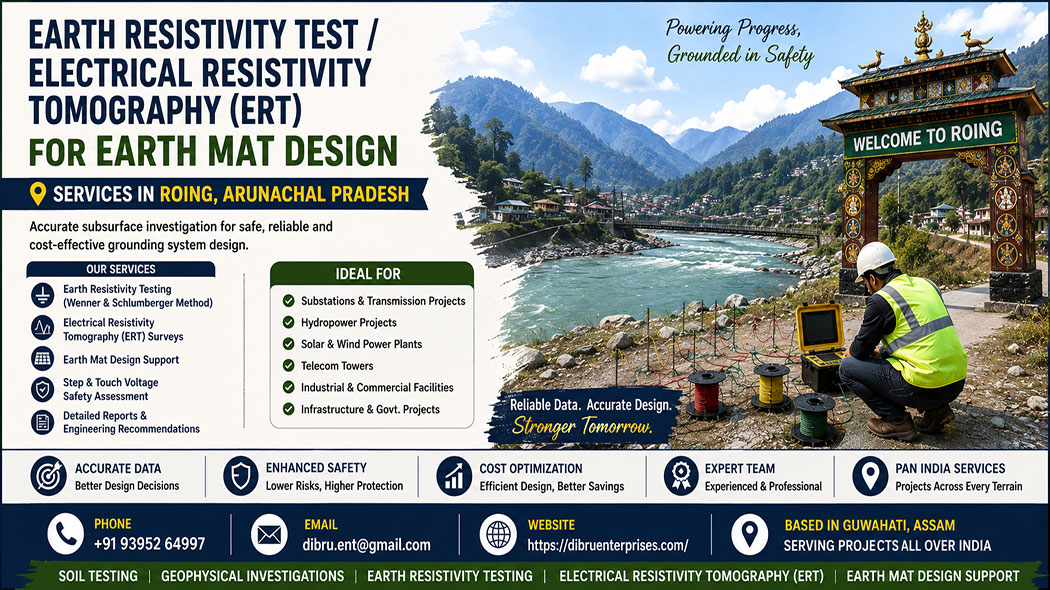
Earth Resistivity Test and Electrical Resistivity Tomography (ERT) for Earth Mat Design in Roing, Arunachal Pradesh
Modern electrical infrastructure depends heavily on safe and efficient grounding systems. Whether a project involves a power substation, hydropower facility, telecom tower, solar plant, industrial unit, or government infrastructure, the design of a reliable earthing system begins with understanding the electrical characteristics of the soil. Earth Resistivity Testing and Electrical Resistivity Tomography (ERT) are essential investigations that provide the foundation for safe and cost-effective earth mat design.
Dibru Enterprises Overseas, based in Guwahati, Assam, offers professional Earth Resistivity Test and Electrical Resistivity Tomography (ERT) services in Roing, Arunachal Pradesh, and across India. With extensive experience in soil testing and geophysical investigations, the company assists consultants, contractors, government agencies, utilities, and infrastructure developers in obtaining accurate subsurface data for electrical grounding design.
Importance of Earth Resistivity Testing
Every soil type responds differently to electrical current. Factors such as moisture content, soil composition, mineral concentration, temperature, and geological conditions directly influence electrical resistivity.
Earth resistivity testing helps determine:
- Soil resistivity values at various depths
- Ground conductivity characteristics
- Suitability of earthing locations
- Earthing electrode requirements
- Grounding grid dimensions
- Earth mat design parameters
- Electrical safety requirements
Without actual field measurements, grounding systems may be either under-designed or excessively expensive. Accurate testing allows engineers to optimize safety and construction costs simultaneously.
What is Electrical Resistivity Tomography (ERT)?
Electrical Resistivity Tomography is an advanced geophysical survey technique that maps subsurface resistivity variations. Unlike conventional soil resistivity testing, ERT provides a detailed image of underground conditions.
The method involves placing a series of electrodes along the ground surface. Specialized equipment injects electrical current into the ground and measures resistivity responses. The collected data is processed using advanced software to generate subsurface resistivity profiles.
ERT surveys help identify:
- Soil layers
- Weathered zones
- Hard rock formations
- Fractured rock structures
- Moisture-rich regions
- Groundwater-bearing layers
- Geological discontinuities
For projects in Roing and surrounding areas, ERT surveys provide valuable information that supports effective earth mat design and infrastructure planning.
Understanding Roing’s Geological Environment
Roing is located in the Lower Dibang Valley district of Arunachal Pradesh and serves as an important gateway to the eastern Himalayan region. The area possesses a unique combination of plains, foothills, river valleys, and mountainous terrain.
Ground conditions in Roing differ significantly from many other parts of India. These variations directly affect grounding system performance and make site-specific investigations essential.
River Valley Influence
Roing lies near the Dibang River basin, where alluvial deposits are common. Such deposits often contain varying mixtures of sand, gravel, silt, and clay.
Electrical resistivity values can vary substantially depending on soil composition and groundwater conditions.
Mixed Terrain Conditions
The region transitions from relatively flat river plains to rugged hill slopes within short distances. Grounding system requirements may change significantly across a project site.
High Rainfall Environment
Roing receives considerable rainfall throughout the year. Seasonal moisture fluctuations influence soil conductivity and affect long-term grounding performance.
Weathered Rock Formations
Several project locations may encounter weathered rock layers beneath the surface. These formations often provide different electrical properties compared to surrounding soils.
Subsurface Water Variations
Groundwater distribution influences soil conductivity. Identifying water-bearing zones can help improve earthing system performance.
Due to these diverse geological conditions, professional Earth Resistivity Testing and ERT surveys become highly valuable before designing grounding systems.
Why Earth Mat Design Requires Accurate Soil Data
An earth mat serves as a network of buried conductors designed to safely dissipate fault currents into the ground.
The effectiveness of an earth mat depends on:
- Soil resistivity
- Moisture content
- Groundwater conditions
- Electrode depth
- Conductor arrangement
- Site geology
When engineers design earth mats using accurate field data, they can achieve:
- Lower grounding resistance
- Improved fault current dissipation
- Reduced step voltage
- Reduced touch voltage
- Enhanced equipment protection
- Better personnel safety
In regions such as Roing, where soil and geological conditions may change considerably across a project area, reliable resistivity data becomes critical.
Applications of Earth Resistivity Testing in Roing
Numerous infrastructure sectors require professional soil resistivity investigations before construction.
Power Substations
Electrical substations handle significant fault currents. Proper grounding systems are necessary to protect personnel and equipment.
Hydropower Projects
Arunachal Pradesh has immense hydropower potential. Grounding systems play a critical role in power generation facilities, switchyards, and transmission infrastructure.
Transmission Line Projects
Transmission towers require effective earthing systems to withstand lightning strikes and fault currents.
Solar Power Installations
Renewable energy projects rely on grounding systems for operational safety and equipment protection.
Telecom Towers
Communication towers need reliable earthing systems to protect sensitive electronics from lightning and electrical surges.
Industrial Developments
Factories and industrial facilities require grounding systems that comply with electrical safety standards.
Government Infrastructure
Public buildings, educational institutions, healthcare facilities, and administrative complexes benefit from properly designed earthing systems.
Advantages of Electrical Resistivity Tomography in Roing
While traditional resistivity testing provides valuable point-based measurements, ERT offers a broader understanding of subsurface conditions.
Identification of Conductive Zones
ERT helps locate areas with lower resistivity that may improve grounding performance.
Mapping Subsurface Variability
The technique reveals geological changes that could impact earthing system design.
Detection of Bedrock
Hard rock formations often exhibit higher resistivity. Identifying their depth assists engineers in selecting appropriate grounding methods.
Groundwater Investigation
Water-bearing zones frequently enhance conductivity. Locating these zones can improve earth mat efficiency.
Better Infrastructure Planning
Detailed subsurface information helps reduce uncertainties during project development.
Reduced Construction Risks
Understanding underground conditions before excavation minimizes unexpected challenges during installation.
Common Methods Used for Soil Resistivity Surveys
Dibru Enterprises Overseas employs internationally recognized testing methods to obtain reliable field data.
Wenner Four-Pin Method
This widely accepted method measures soil resistivity at different electrode spacings.
Benefits include:
- High reliability
- Industry acceptance
- Suitable for grounding calculations
- Efficient field implementation
Schlumberger Method
This technique allows deeper subsurface investigations and provides valuable geological information.
Advantages include:
- Greater depth penetration
- Improved subsurface profiling
- Effective geological interpretation
Electrical Resistivity Tomography
ERT provides comprehensive subsurface imaging and detailed resistivity mapping.
The method is especially useful in geologically complex regions such as Arunachal Pradesh.
Factors Affecting Soil Resistivity in Roing
Several natural factors influence soil resistivity values.
Soil Composition
Clay-rich soils generally exhibit lower resistivity than sandy or rocky soils.
Moisture Content
Higher moisture levels often improve electrical conductivity.
Temperature
Temperature changes can influence soil resistance characteristics.
Mineral Content
Dissolved minerals and salts affect soil conductivity.
Geological Structure
Rock formations, fractures, and weathered zones contribute to resistivity variations.
Groundwater Presence
Water-bearing layers frequently reduce soil resistivity.
These factors highlight the importance of conducting actual field investigations rather than relying on assumptions.
Benefits of Professional Resistivity Testing
Accurate investigations provide substantial long-term advantages.
Enhanced Electrical Safety
Reliable grounding systems help protect personnel from dangerous voltages.
Cost Optimization
Engineering designs based on actual data reduce unnecessary construction expenses.
Improved Reliability
Proper grounding contributes to stable system performance under fault conditions.
Regulatory Compliance
Many projects require documented soil resistivity data for approvals and design verification.
Better Engineering Decisions
Detailed reports support informed planning and construction.
Deliverables Provided by Dibru Enterprises Overseas
Clients receive comprehensive technical reports containing essential information for design and engineering purposes.
Typical deliverables include:
- Site investigation records
- Soil resistivity measurements
- Apparent resistivity curves
- Geological interpretations
- ERT cross-sections
- Subsurface resistivity models
- Engineering recommendations
- Earth mat design support data
- Technical conclusions
These reports assist consultants and project engineers during design and implementation phases.
Why Choose Dibru Enterprises Overseas?
Dibru Enterprises Overseas has established itself as a trusted provider of soil testing and geophysical investigation services throughout India.
Extensive Industry Experience
The company serves clients across power, infrastructure, industrial, telecom, renewable energy, and government sectors.
Expertise in Northeastern India
Knowledge of regional geological conditions enables efficient planning and execution of field investigations.
Advanced Equipment
Modern testing instruments help ensure reliable and accurate data collection.
Qualified Technical Team
Experienced professionals conduct surveys according to accepted engineering standards.
Nationwide Service Capability
Projects can be undertaken in urban centers, remote locations, mountainous terrain, river valleys, and industrial zones across India.
Detailed Reporting
Comprehensive reports support engineering design, project approvals, and technical documentation.
Growing Infrastructure Development in Roing
Roing continues to witness infrastructure expansion through road construction, power transmission projects, hydropower development, government facilities, tourism infrastructure, and communication networks.
As investments increase, the need for dependable electrical grounding systems becomes increasingly important. Earth Resistivity Testing and Electrical Resistivity Tomography provide the technical foundation required for safe and efficient project execution.
Accurate subsurface investigations help developers minimize risks while improving the long-term performance of electrical installations.
Contact Dibru Enterprises Overseas
For Earth Resistivity Testing, Electrical Resistivity Tomography (ERT), soil investigations, and earth mat design support in Roing, Arunachal Pradesh, contact:
Dibru Enterprises Overseas
Phone: +91 93952 64997
Email: dibru.ent@gmail.com
Website: https://dibruenterprises.com/
Based in Guwahati, Assam, Dibru Enterprises Overseas provides professional soil testing, geotechnical investigations, geophysical surveys, Earth Resistivity Testing, and ERT services for projects throughout India.
Conclusion
Designing an effective earth mat requires more than standard calculations. Grounding performance depends directly on actual subsurface conditions, especially in regions with diverse geology such as Roing, Arunachal Pradesh. Earth Resistivity Testing and Electrical Resistivity Tomography offer the detailed information necessary to develop safe, reliable, and cost-effective grounding systems.
With advanced equipment, experienced professionals, and extensive expertise in soil testing and geophysical investigations, Dibru Enterprises Overseas delivers dependable services that support successful infrastructure development across Arunachal Pradesh and throughout India.
Related Posts

This Post Has 0 Comments