
Groundwater Investigation (Electrical Resistivity Survey / VES) Services in Namsai, Arunachal Pradesh by Dibru Enterprises…
Groundwater Investigation in Roing: Electrical Resistivity Survey (VES)
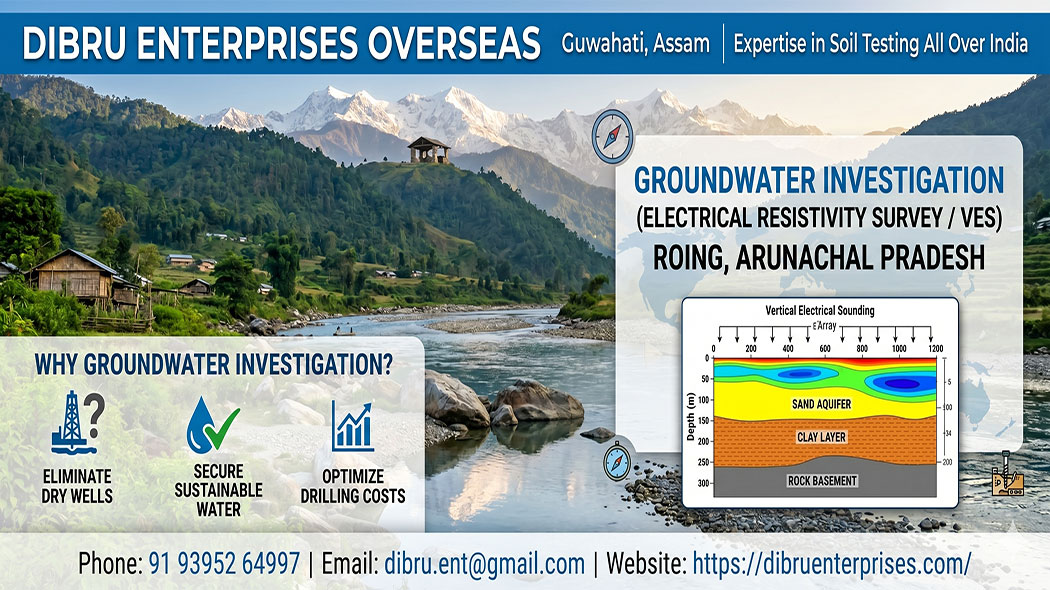
Groundwater Investigation Services in Roing, Arunachal Pradesh
Groundwater plays a vital role in the development of residential, commercial, agricultural, and infrastructure projects in Arunachal Pradesh. In regions like Roing, identifying sustainable underground water sources requires scientific investigation due to the area’s varied terrain, geological complexity, and seasonal rainfall patterns. Proper groundwater assessment helps reduce the risk of failed borewells and ensures reliable water availability for long-term use.
Dibru Enterprises Overseas, based in Guwahati, offers professional Groundwater Investigation services using Electrical Resistivity Survey and Vertical Electrical Sounding (VES) methods. The company provides advanced soil testing and geophysical survey solutions across India, including remote and challenging locations in Arunachal Pradesh.
With extensive experience in hydrogeological investigation and subsurface analysis, Dibru Enterprises Overseas assists industries, contractors, government departments, institutions, tea estates, infrastructure developers, and private clients in locating suitable groundwater zones with scientific precision.
Understanding Groundwater Investigation
Groundwater investigation is a scientific process used to determine the presence, depth, quantity, and quality of underground water-bearing formations. The process helps identify suitable drilling points for borewells, tube wells, and water extraction systems.
In hilly and geologically sensitive regions like Roing, conventional guessing methods often fail because underground formations can change rapidly within short distances. Electrical Resistivity Survey techniques help minimize uncertainty by providing detailed information about subsurface layers.
The investigation process usually includes:
- Geological assessment
- Terrain evaluation
- Electrical Resistivity Survey
- Vertical Electrical Sounding (VES)
- Subsurface layer interpretation
- Aquifer identification
- Borewell point recommendation
This scientific approach significantly improves borewell success rates and reduces unnecessary drilling expenses.
Importance of Groundwater Investigation in Roing
Roing is located in the Lower Dibang Valley district of Arunachal Pradesh. The region experiences heavy rainfall, steep slopes, riverine influence, dense vegetation, and complex geological formations. Such environmental conditions make groundwater exploration more challenging compared to plain regions.
Several factors affect groundwater occurrence in Roing:
Hilly Terrain and Sloping Land
Roing contains uneven topography with hill slopes and valley zones. Water movement beneath the ground differs significantly between elevated areas and lower valleys. In sloping terrains, groundwater often migrates through fractures and weathered rock zones instead of remaining uniformly distributed.
Electrical Resistivity Survey helps identify hidden fracture systems and water-bearing formations beneath rocky layers.
Rocky and Mixed Geological Formations
Large parts of Arunachal Pradesh contain hard rock formations, metamorphic rocks, and compact geological structures. Water availability depends heavily on fractures, joints, and weathered zones within rocks.
Traditional drilling without investigation may lead to dry borewells. Scientific VES surveys help determine:
- Rock depth
- Fracture zones
- Water saturation areas
- Thickness of weathered layers
- Suitable drilling depth
Heavy Rainfall and Seasonal Variations
Roing receives substantial rainfall during monsoon seasons. Although rainfall remains high, groundwater storage characteristics vary based on soil composition and rock permeability.
Some locations may retain groundwater effectively, while others lose water quickly through runoff. Proper investigation helps identify locations with sustainable underground storage capacity.
Infrastructure and Development Needs
Rapid development activities in Arunachal Pradesh have increased demand for reliable groundwater sources. Residential projects, schools, hospitals, roads, government establishments, industrial units, and commercial buildings require dependable water supply systems.
Groundwater investigation ensures proper planning before borewell drilling begins.
What is Electrical Resistivity Survey (ERS)?
Electrical Resistivity Survey is a geophysical method used to study underground formations by measuring the resistance of soil and rocks to electrical current.
Different subsurface materials exhibit different resistivity values:
- Dry rocks show high resistivity
- Water-bearing formations show lower resistivity
- Clay layers exhibit distinct conductivity patterns
- Fractured rocks saturated with water produce identifiable readings
The survey involves placing electrodes on the ground surface and passing controlled electrical current through the earth. The resulting data helps geophysicists interpret underground geological conditions.
Benefits of Electrical Resistivity Survey
Accurate Borewell Point Identification
ERS helps determine suitable drilling locations with better groundwater potential.
Reduced Drilling Failure Risk
Scientific analysis minimizes random drilling and dry borewell failures.
Cost Optimization
Proper investigation prevents unnecessary drilling expenses and repeated attempts.
Depth Estimation
VES surveys estimate groundwater depth and drilling requirements.
Suitable for Difficult Terrain
The method works effectively in hilly, rocky, and uneven landscapes like Roing.
Vertical Electrical Sounding (VES) for Groundwater Detection
Vertical Electrical Sounding is one of the most widely used techniques in groundwater exploration. VES studies the variation of electrical resistivity with depth.
This method helps identify:
- Weathered rock thickness
- Fracture zones
- Aquifer layers
- Bedrock depth
- Groundwater-bearing strata
In regions like Roing where subsurface conditions vary significantly, VES becomes extremely valuable for hydrogeological investigation.
Applications of VES Surveys in Roing
VES surveys are useful for:
- Borewell site selection
- Rural water supply projects
- Institutional water planning
- Industrial groundwater exploration
- Agricultural irrigation planning
- Infrastructure projects
- Government development works
- Hill area water assessment
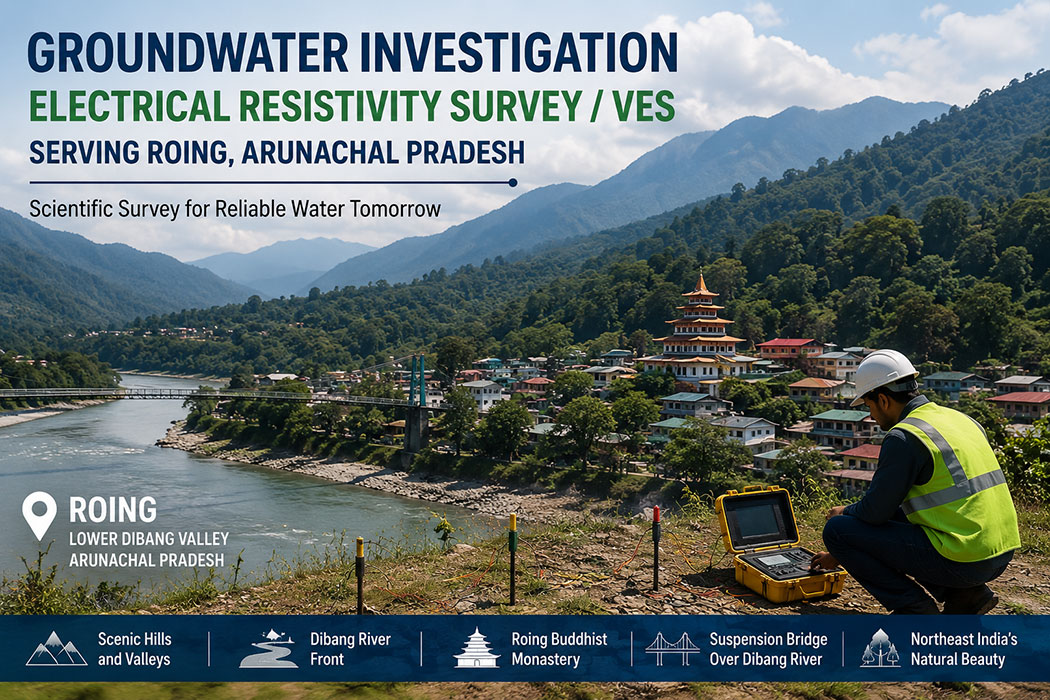
Soil Testing Expertise by Dibru Enterprises Overseas
Apart from groundwater investigation, Dibru Enterprises Overseas also specializes in soil testing services across India.
Soil investigation plays a critical role in construction and infrastructure planning. In hilly states like Arunachal Pradesh, soil properties can vary dramatically due to slope instability, erosion, and geological diversity.
The company provides soil testing solutions for:
- Building construction
- Road projects
- Bridges
- Retaining structures
- Industrial facilities
- Commercial developments
- Government infrastructure projects
Importance of Soil Testing in Roing
The terrain in Roing often includes loose soil deposits, weathered rocks, river sediments, and slope-sensitive areas. Soil testing helps engineers determine:
- Bearing capacity
- Soil stability
- Foundation suitability
- Moisture content
- Compaction characteristics
- Settlement risks
Combining groundwater investigation with soil testing provides a comprehensive understanding of subsurface conditions.
Groundwater Challenges in Arunachal Pradesh
Although Arunachal Pradesh receives abundant rainfall, groundwater exploration remains technically challenging in many locations.
Fractured Rock Aquifers
Hard rock terrains often store groundwater within fractures instead of porous layers. These fractures can be narrow and discontinuous. Identifying productive fracture zones requires detailed geophysical analysis.
Landslide-Prone Areas
Slope instability affects groundwater recharge and subsurface water movement. Scientific surveys help avoid unstable drilling zones.
Remote Accessibility
Several project sites in Arunachal Pradesh remain difficult to access. Experienced field teams and portable geophysical equipment become essential for conducting surveys efficiently.
River Influence
Roing lies near major river systems. River proximity affects groundwater recharge patterns and sediment distribution. Electrical Resistivity Survey helps differentiate between shallow saturated zones and sustainable aquifers.
Why Choose Dibru Enterprises Overseas?
Experienced Technical Team
The company uses scientific investigation methods supported by experienced professionals in geophysical and soil testing services.
Advanced Survey Techniques
Modern resistivity survey equipment ensures reliable field data collection and accurate interpretation.
Services Across India
Although based in Assam, the company provides services nationwide, including remote and hilly regions.
Understanding of Northeast India Terrain
The northeastern region presents unique geological conditions. Dibru Enterprises Overseas understands the environmental and terrain-specific challenges associated with groundwater investigation in Arunachal Pradesh.
Customized Survey Solutions
Every project site differs in geology and water requirements. The company conducts location-specific assessments for better results.
Industries and Sectors Served
Groundwater investigation and soil testing services are essential for various sectors.
Residential Construction
Housing projects require dependable water sources and safe foundation planning.
Government Projects
Public infrastructure projects need scientific hydrogeological assessment before execution.
Educational Institutions
Schools, colleges, and hostels require sustainable water supply systems.
Agriculture and Irrigation
Farmers and plantation owners benefit from groundwater identification for irrigation planning.
Industrial Projects
Industrial facilities require reliable water sources for operational requirements.
Infrastructure Development
Roads, bridges, and hill infrastructure projects require soil and groundwater assessment.
Scientific Approach to Borewell Site Selection
Random borewell drilling often results in financial loss and water scarcity issues. Scientific groundwater investigation improves drilling success probability through systematic analysis.
The process generally includes:
- Site reconnaissance
- Geological mapping
- Terrain assessment
- Electrical resistivity measurements
- Data interpretation
- Aquifer identification
- Borewell point recommendation
- Suggested drilling depth estimation
This approach supports better groundwater management and long-term sustainability.
Importance of Sustainable Groundwater Development
Groundwater resources must be utilized responsibly to maintain long-term availability. Scientific investigation helps avoid excessive drilling and improves resource management.
Sustainable groundwater development supports:
- Water conservation
- Efficient extraction
- Reduced environmental impact
- Improved rural development
- Better infrastructure planning
In environmentally sensitive regions like Arunachal Pradesh, scientific groundwater exploration becomes especially important.
Future Demand for Groundwater Investigation in Roing
Roing continues to witness growth in tourism, infrastructure development, institutional expansion, and residential construction. Reliable groundwater assessment will remain crucial for future projects.
Increasing awareness about scientific borewell investigation has encouraged organizations and individuals to adopt Electrical Resistivity Survey methods before drilling activities.
As development expands across Arunachal Pradesh, professional hydrogeological investigation services will play a greater role in ensuring dependable water supply systems.
Contact Dibru Enterprises Overseas
For Groundwater Investigation, Electrical Resistivity Survey (VES), Borewell Site Selection, and Soil Testing Services in Roing and across India, contact:
Dibru Enterprises Overseas
- Phone: +91 93952 64997
- Email: dibru.ent@gmail.com
- Location: Guwahati
The company provides professional geophysical investigation and soil testing solutions tailored to different terrains and project requirements throughout India.
Conclusion
Groundwater investigation in Roing, Arunachal Pradesh requires scientific expertise due to the region’s hilly terrain, rocky geological formations, and varying subsurface conditions. Electrical Resistivity Survey and Vertical Electrical Sounding techniques provide reliable methods for locating groundwater-bearing zones and reducing borewell failure risks.
Dibru Enterprises Overseas offers professional groundwater investigation and soil testing services backed by technical knowledge and modern survey practices. From borewell point identification to subsurface analysis, the company supports sustainable water resource planning across Arunachal Pradesh and other regions of India.
Scientific groundwater exploration not only improves drilling success but also contributes to better infrastructure development, water security, and long-term resource management in challenging terrains like Roing.
Related Posts
This Post Has 0 Comments