
Groundwater Investigation (Electrical Resistivity Survey / VES) Services in Aalo, Arunachal Pradesh by Dibru Enterprises…
Groundwater Investigation in Namsai, Arunachal Pradesh | Electrical Resistivity Survey (VES) Services
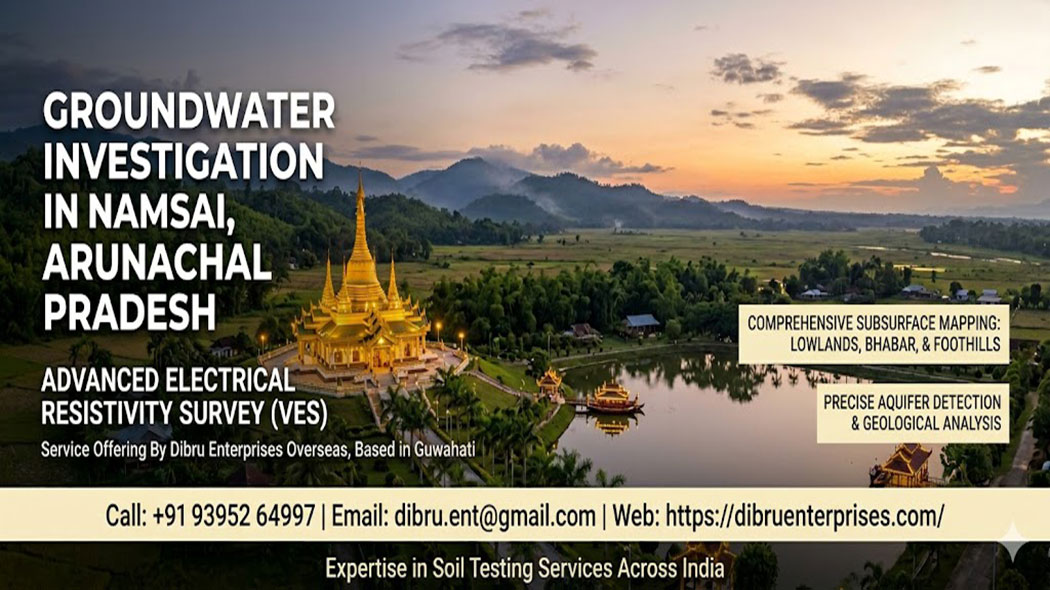
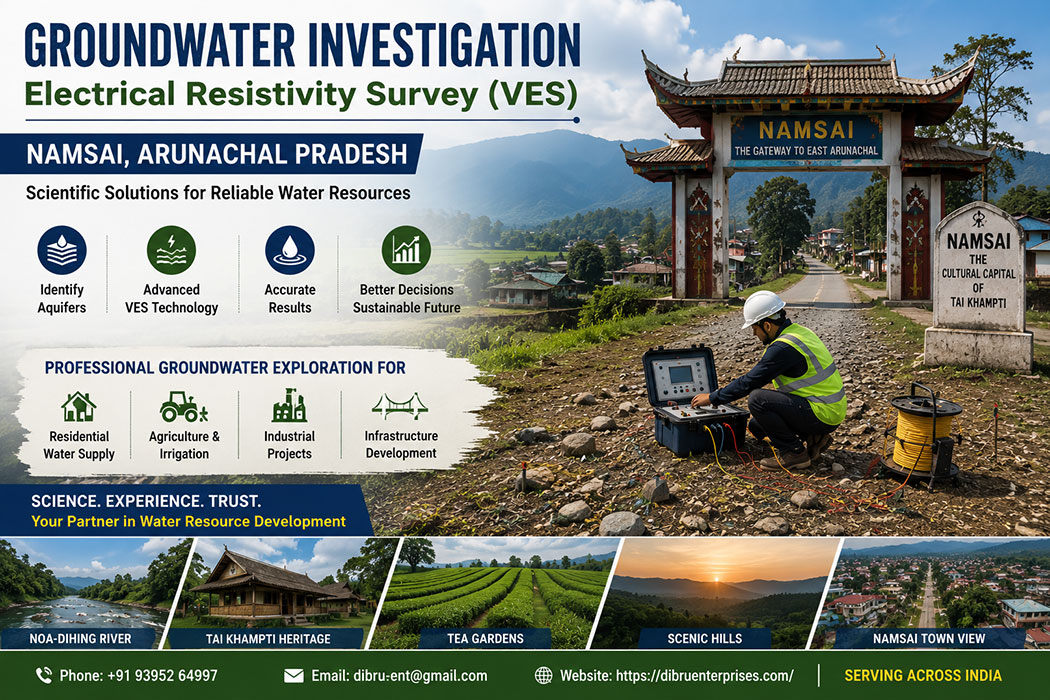
Groundwater Investigation (Electrical Resistivity Survey / VES) Services in Namsai, Arunachal Pradesh by Dibru Enterprises Overseas
Groundwater plays a vital role in supporting residential development, agriculture, commercial projects, and public infrastructure. In a geographically diverse region like Namsai, Arunachal Pradesh, locating dependable underground water sources requires scientific investigation and technical expertise. Dibru Enterprises Overseas, based in Guwahati, Assam, offers advanced Groundwater Investigation services using Electrical Resistivity Survey (ERS) and Vertical Electrical Sounding (VES) methods to identify suitable groundwater zones with precision.
The company also specializes in soil testing and geotechnical investigation services across India. Their expertise helps clients make informed decisions before drilling borewells or starting construction projects.
Importance of Groundwater Investigation in Namsai
Namsai district is known for its fertile plains, river-fed areas, and mixed geological conditions. Although groundwater availability is generally better in comparison to high-altitude hill districts, subsurface water distribution can still vary significantly from one location to another.
Factors influencing groundwater occurrence in Namsai include:
- Soil composition
- Sedimentary formations
- Water table fluctuations
- Seasonal rainfall
- River and stream recharge
- Clay and sand layer distribution
Random drilling often leads to poor borewell performance or dry wells. Scientific groundwater investigation minimizes such risks and improves drilling success rates.
Understanding Electrical Resistivity Survey (ERS)
Electrical Resistivity Survey is a geophysical technique used to study underground formations by measuring the resistance of soil and rock layers to electrical current.
Different underground materials show different resistivity values:
- Saturated sand layers usually have low resistivity
- Hard rocks show higher resistivity
- Clay formations often display distinct electrical characteristics
- Water-bearing zones can be identified through interpretation of resistivity patterns
This method provides valuable information about the subsurface without excavation.
What is Vertical Electrical Sounding (VES)?
Vertical Electrical Sounding is one of the most effective techniques for groundwater exploration. The method investigates variations in subsurface resistivity with depth.
VES helps determine:
- Depth of aquifers
- Thickness of water-bearing layers
- Geological formations
- Fracture zones
- Suitable drilling depth
The technique is widely used for groundwater exploration in plains, valleys, semi-rocky terrain, and hilly regions.
Terrain Conditions in Namsai and Their Impact on Groundwater Survey
Namsai district has a unique combination of plain land, low-lying areas, agricultural fields, and riverine deposits. Unlike steep mountainous terrain, the district often contains thick alluvial deposits that can store groundwater effectively.
However, groundwater behavior changes depending on local geology.
-
Riverine and Floodplain Areas
Many parts of Namsai receive recharge from nearby rivers and seasonal streams.
Characteristics include:
- Shallow groundwater table
- Sandy and silty formations
- High recharge potential
- Seasonal fluctuations during monsoon
Electrical resistivity surveys help determine:
- Thickness of aquifer zones
- Safe drilling depth
- Groundwater quality zones
-
Agricultural Plains
Agricultural activities in Namsai require sustainable water sources.
Groundwater surveys in farming areas focus on:
- Irrigation borewell planning
- Aquifer continuity
- Water yield estimation
- Long-term groundwater sustainability
VES investigations help farmers avoid unproductive drilling expenses.
-
Clay-Dominated Areas
Certain locations may contain clay-rich soil layers.
Challenges in such areas:
- Low permeability
- Reduced groundwater movement
- Difficulty in identifying productive aquifers
Geophysical surveys differentiate clay zones from water-bearing sand formations.
-
Semi-Rocky Regions
Some peripheral areas near elevated terrain may contain weathered or fractured rock formations.
Groundwater occurrence in rocky areas depends on:
- Fracture density
- Weathering thickness
- Geological discontinuities
VES surveys accurately locate fracture-controlled groundwater zones.
Services Offered by Dibru Enterprises Overseas
Dibru Enterprises Overseas provides a broad range of hydrogeological and geotechnical services.
Groundwater Investigation Services
- Electrical Resistivity Survey (ERS)
- Vertical Electrical Sounding (VES)
- Borewell site selection
- Aquifer identification
- Hydrogeological investigation
- Groundwater potential assessment
Soil Testing Services
The company has extensive experience in soil investigation for construction and infrastructure projects.
Services include:
- Soil bearing capacity testing
- Soil classification
- Moisture content analysis
- Compaction testing
- Geotechnical investigation
- Foundation investigation
Project Support Services
Dibru Enterprises Overseas also supports:
- Government projects
- Residential developments
- Industrial construction
- Road and bridge projects
- Water supply planning
The company operates across India and delivers reliable technical services in urban and remote locations.
Why Scientific Groundwater Investigation is Necessary
Groundwater exploration without proper investigation often results in:
- Dry borewells
- Low water yield
- Increased drilling cost
- Poor water quality
- Structural drilling issues
Scientific surveys improve the probability of successful groundwater extraction.
Benefits include:
- Reduced financial risk
- Better drilling accuracy
- Efficient water resource management
- Time savings
- Sustainable groundwater utilization
Process of Electrical Resistivity Survey
Dibru Enterprises Overseas follows a systematic process for groundwater investigation.
Step 1: Site Inspection
The team conducts field reconnaissance to understand:
- Terrain condition
- Geological setting
- Accessibility
- Surface indicators
Step 2: Survey Planning
Based on site conditions:
- Electrode configurations are selected
- Survey lines are planned
- Measurement depth is estimated
Step 3: Field Data Collection
Electrical current is introduced into the ground using specialized equipment.
Measurements are recorded for:
- Apparent resistivity
- Subsurface layer response
- Depth-related variations
Step 4: Data Interpretation
Collected data is analyzed using geophysical interpretation methods.
The analysis identifies:
- Aquifer zones
- Water-bearing formations
- Hard rock layers
- Clay and sand distribution
Step 5: Final Reporting
Clients receive detailed reports containing:
- Survey findings
- Recommended drilling points
- Estimated groundwater depth
- Geological interpretation
Advantages of Electrical Resistivity Survey in Namsai
Non-Destructive Method
No excavation or land damage occurs during the survey.
High Accuracy
The method provides reliable information about underground conditions.
Cost Savings
Accurate site selection reduces failed drilling attempts.
Suitable for Different Terrain Types
ERS and VES methods work effectively in:
- Plains
- Agricultural land
- Semi-rocky areas
- Riverine zones
Faster Decision-Making
Quick interpretation helps clients proceed with drilling projects efficiently.
Expertise of Dibru Enterprises Overseas
Experience Across India
The company has experience working in diverse geological conditions throughout India.
Advanced Equipment
Modern resistivity instruments improve data quality and survey accuracy.
Skilled Technical Team
Professionals with expertise in:
- Hydrogeology
- Geophysics
- Soil engineering
- Geological interpretation
handle each project carefully.
Customized Approach
Every site receives location-specific investigation strategies based on:
- Terrain
- Geological formation
- Water requirement
- Project purpose
Applications of Groundwater Investigation Services
Residential Water Supply
Households require reliable borewell locations for long-term water access.
Agriculture and Irrigation
Farmers need sustainable groundwater sources for crop production.
Commercial Projects
Hotels, institutions, and commercial buildings depend on proper water planning.
Industrial Use
Factories and industrial facilities require adequate groundwater availability for operations.
Infrastructure Projects
Roads, bridges, and public utilities often require hydrogeological and soil investigation.
Groundwater Sustainability in Arunachal Pradesh
Groundwater management has become increasingly important due to changing rainfall patterns and growing water demand.
Sustainable practices include:
- Controlled groundwater extraction
- Rainwater harvesting
- Aquifer recharge measures
- Scientific borewell planning
Groundwater surveys contribute to long-term resource conservation.
Challenges in Groundwater Exploration
Despite favorable groundwater conditions in many parts of Namsai, several challenges still exist.
Seasonal Water Table Variations
Monsoon recharge can alter groundwater depth significantly.
Mixed Soil Layers
Alternating clay, sand, and gravel layers complicate aquifer identification.
Local Geological Variability
Subsurface conditions may change within short distances.
Over-Dependence on Random Drilling
Unscientific drilling practices often waste resources and money.
Professional surveys reduce these uncertainties substantially.
Why Choose Dibru Enterprises Overseas in Namsai
Clients choose Dibru Enterprises Overseas because of:
- Technical expertise
- Reliable reporting
- Modern survey methods
- Pan-India service capability
- Understanding of Northeast India terrain
- Professional field execution
The company delivers dependable investigation services tailored to local conditions.
Contact Details
Dibru Enterprises Overseas
Phone: +91 93952 64997
Email: dibru.ent@gmail.com
Website: Dibru Enterprises Overseas
Conclusion
Groundwater investigation in Namsai, Arunachal Pradesh, requires careful scientific assessment to ensure reliable and sustainable water sourcing. Electrical Resistivity Survey and Vertical Electrical Sounding techniques provide accurate subsurface information that helps identify productive groundwater zones.
Dibru Enterprises Overseas combines regional expertise, advanced equipment, and professional technical knowledge to deliver high-quality groundwater and soil investigation services. Whether the requirement involves irrigation, residential water supply, industrial use, or infrastructure development, the company provides customized solutions suited to local geological conditions.
Scientific groundwater investigation not only improves borewell success rates but also supports responsible groundwater management for future generations.
Related Posts
This Post Has 0 Comments