
Driving Structural Excellence: Geotechnical Investigation Services in Jangipur, West Bengal When it comes to construction,…
Geotechnical Investigation in Haldia West Bengal | Soil Testing
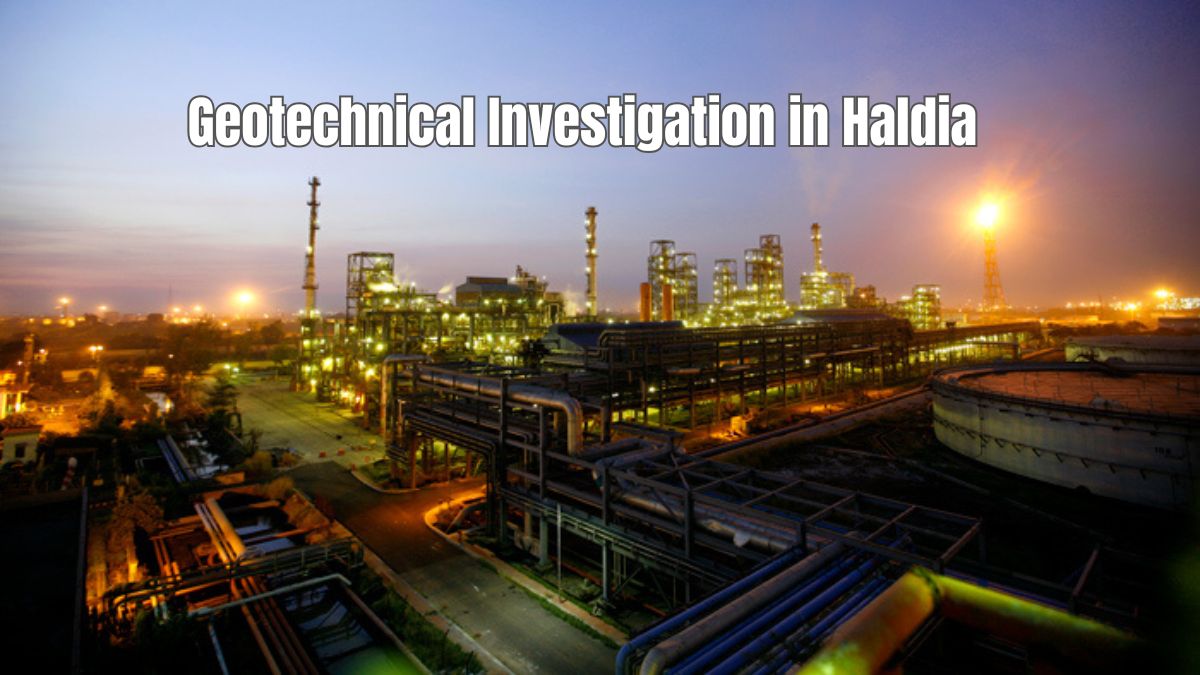
Strategic Geotechnical Investigation and Subsurface Analysis in Haldia, West Bengal: A Specialized Approach by Dibru Enterprises Overseas
The Industrial Gateway: Engineering on Haldia’s Complex Subsurface
Haldia, the premier industrial port city of West Bengal, serves as the backbone of the state’s petrochemical and maritime economy. Situated at the confluence of the Hooghly and Haldi rivers, the region is characterized by heavy industrial infrastructure, massive refinery complexes, and sprawling port facilities. However, the very proximity to the river system that makes Haldia an economic powerhouse also makes it one of the most challenging environments for civil and structural engineering.
Dibru Enterprises Overseas, based in Guwahati, Assam, brings a wealth of expertise in Geotechnical Investigation and Geophysical Exploration to the Haldia industrial belt. With a pan-India service footprint, we specialize in navigating the unique challenges of coastal and estuarine geology. In Haldia, where the ground consists of deep marine deposits and soft sediments, a precise scientific understanding of the subsurface is the difference between a successful project and a structural catastrophe.
The Geological Reality of Haldia: Marine Clays and Deltaic Deposits
Haldia is situated in the lower deltaic plain of the Ganges-Brahmaputra Delta. Unlike the rocky outcrops found in Western India or the hilly terrains of the Northeast, Haldia’s geology is defined by its Marine and Estuarine origins.
- The Challenge of “Haldia Soft Clay”
A primary feature of the subsurface in this region is the presence of thick layers of soft to very soft marine clay. These layers often have high natural moisture content, sometimes exceeding their liquid limits.
- Engineering Impact: These clays are highly compressible and exhibit “Low Shear Strength.” If a heavy oil tank or industrial chimney is built without proper investigation, the building can undergo significant “Primary and Secondary Consolidation” settlement over several decades.
- Deep Alluvial Strata
The “Founding Strata”—the layer strong enough to support deep foundations—is often found at great depths in Haldia, sometimes exceeding 40 to 50 meters.
- Engineering Impact: This necessitates the design of deep bored cast-in-situ piles. Our investigations pinpoint the exact depth where the soil transitions from soft clay to dense sand or stiff clay.
- Shallow Groundwater and Salinity
Being a port city, the water table in Haldia is extremely high and often influenced by tidal fluctuations.
- Engineering Impact: The groundwater in coastal zones like Haldia is often saline. This chemical composition is aggressive toward concrete and steel. Our chemical analysis helps engineers specify sulfate-resistant cement and protective coatings for foundations.
Our Specialized Geotechnical Service Offerings in Haldia
Dibru Enterprises Overseas provides an integrated suite of field and laboratory services designed to mitigate the risks associated with coastal industrial construction.
- Field Exploration and In-Situ Testing
- Standard Penetration Test (SPT): This is the fundamental test for assessing soil density. In the soft clays of Haldia, we use specialized equipment to record even the lowest blow counts accurately, which is vital for calculating the soil’s undrained shear strength.
- Borehole Drilling: We employ rotary wash boring and shell-and-auger methods to navigate the soft sediments of Haldia. We are equipped to drill deep boreholes to identify stable founding layers for heavy industrial loads.
- Vane Shear Test (VST): Because the clays in Haldia are often too soft to be sampled without disturbance, the in-situ Vane Shear Test is our preferred method for measuring the shear strength of the soil in its natural state.
- Piezometer Installation: We monitor the pore water pressure and tidal groundwater fluctuations, which are critical for the design of dry docks, basements, and underground storage facilities.
- Geophysical Exploration (Non-Destructive Analysis)
In the high-security and high-density environments of Haldia’s refineries and ports, non-invasive methods are often the most efficient.
- Electrical Resistivity Tomography (ERT): We use ERT to map the lateral extent of clay and sand lenses and to detect saline water intrusion zones that could affect foundation durability.
- Ground Penetrating Radar (GPR): Essential for refinery expansions, GPR locates buried pipelines, cables, and old foundations, preventing hazardous accidents during new excavation.
- Seismic Refraction and MASW: These tests help determine the dynamic properties of the soil, which is a mandatory requirement for designing foundations for heavy vibrating machinery and seismic-resistant structures.
Comparative Terrain Analysis: Why Geography Changes the Methodology
At Dibru Enterprises Overseas, our national experience has taught us that the “situation of the area” dictates the technology and strategy we use.
The Coastal/Plain Situation (Haldia, West Bengal)
- Situation: Soft marine clay, high water table, tidal influence.
- Primary Concern: Long-term settlement and chemical corrosion.
- Work Difficulty: Deep drilling required; focus on pile foundation parameters.
- Our Approach: Extensive consolidation testing and chemical analysis of soil/water.
The Hilly Situation (North Bengal / Assam)
- Situation: Residual soils over weathered rock, steep slopes.
- Primary Concern: Slope stability and landslide mitigation.
- Work Difficulty: Difficult rig mobilization; focus on lateral earth pressure.
- Our Approach: Rock core drilling and inclinometer installation to monitor slope movement.
The Rocky Situation (Western West Bengal / Jharkhand)
- Situation: Hard bedrock near the surface.
- Primary Concern: Excavatability and bearing capacity of the rock mass.
- Work Difficulty: High wear on drilling bits; focus on fractures and joints.
- Our Approach: Diamond core drilling and Rock Quality Designation (RQD) analysis.
Laboratory Testing: Translating Data into Engineering Science
Samples collected from the field in Haldia are sent to our specialized laboratory, where we calculate the mathematical variables required for a safe structural design.
- Consolidation Test: This is the most critical test for Haldia. We calculate the “Compression Index” to predict exactly how many millimeters the structure will settle over its 50-year lifespan.
- Triaxial Shear Test: We determine the “Cohesion” and “Angle of Internal Friction” under various drainage conditions (UU, CU, CD) to simulate the different stages of construction and operation.
- Chemical Analysis: We test the soil and water for pH, chlorides, and sulfates. In the industrial and coastal environment of Haldia, this prevents the “carbonation” and corrosion of foundation reinforcement.
- Permeability Testing: Essential for the design of containment ponds and drainage systems in refineries.
Serving Haldia’s Strategic Industrial Sectors
Our services in Haldia are tailored to meet the rigorous standards of the industrial and maritime sectors:
- Refineries and Petrochemicals: Designing foundations for heavy columns, distillation towers, and storage tanks.
- Port Infrastructure: Providing data for berths, jetties, and dry docks where tidal forces and soft soil overlap.
- Power Plants: Dynamic soil analysis for turbine foundations to prevent vibrational settlement.
- Urban Development: Geotechnical clearance for residential townships and commercial centers supporting the industrial workforce.
The Dibru Enterprises Overseas Advantage
Why should an industrial project in Haldia partner with a firm based in Guwahati?
- Specialization in Marginal Lands: We have extensive experience in building on “difficult” ground. Our work in the Brahmaputra floodplains has prepared us perfectly for the alluvial and estuarine challenges of Haldia.
- Integrated Exploration: We are one of the few firms offering both Geotechnical (mechanical) and Geophysical (physical) services, providing a 360-degree view of the site.
- Advanced Technology: We utilize high-torque drilling rigs and digital SPT systems, ensuring that our data is both accurate and reproducible for multi-billion dollar projects.
- Regulatory and IS Code Compliance: All our investigations follow the Bureau of Indian Standards (IS Codes) and international ASTM standards where required by global industrial consultants.
- Cost-Effective Design: By accurately determining the Safe Bearing Capacity, we often help our clients avoid overly conservative designs, saving significant costs in concrete and piling.
Contact Information
For expert geotechnical and geophysical services in Haldia and across West Bengal, reach out to Dibru Enterprises Overseas.
- Phone: +91 93952 64997
- Email: dibru.ent@gmail.com
- Website: https://dibruenterprises.com/
- Headquarters: Guwahati, Assam (Services available Pan-India)
Conclusion: Engineering a Solid Future for Haldia
Haldia is a city built on the promise of industry, but its structures are only as strong as the soft clay they sit upon. In a deltaic environment, ignoring the subsurface is not an option. A professional Geotechnical Investigation is the primary insurance policy for any industrial investment, ensuring that the heavy infrastructure of today does not become the structural failure of tomorrow.
At Dibru Enterprises Overseas, we are committed to providing the technical precision and scientific integrity needed to build a safer Haldia. Whether you are expanding a refinery or building a new port facility, we find the solid ground you need to grow.
Related Posts
This Post Has 0 Comments