
Driving Structural Excellence: Geotechnical Investigation Services in Jangipur, West Bengal When it comes to construction,…
Geotechnical Investigation in Howrah, West Bengal | Soil Testing Services
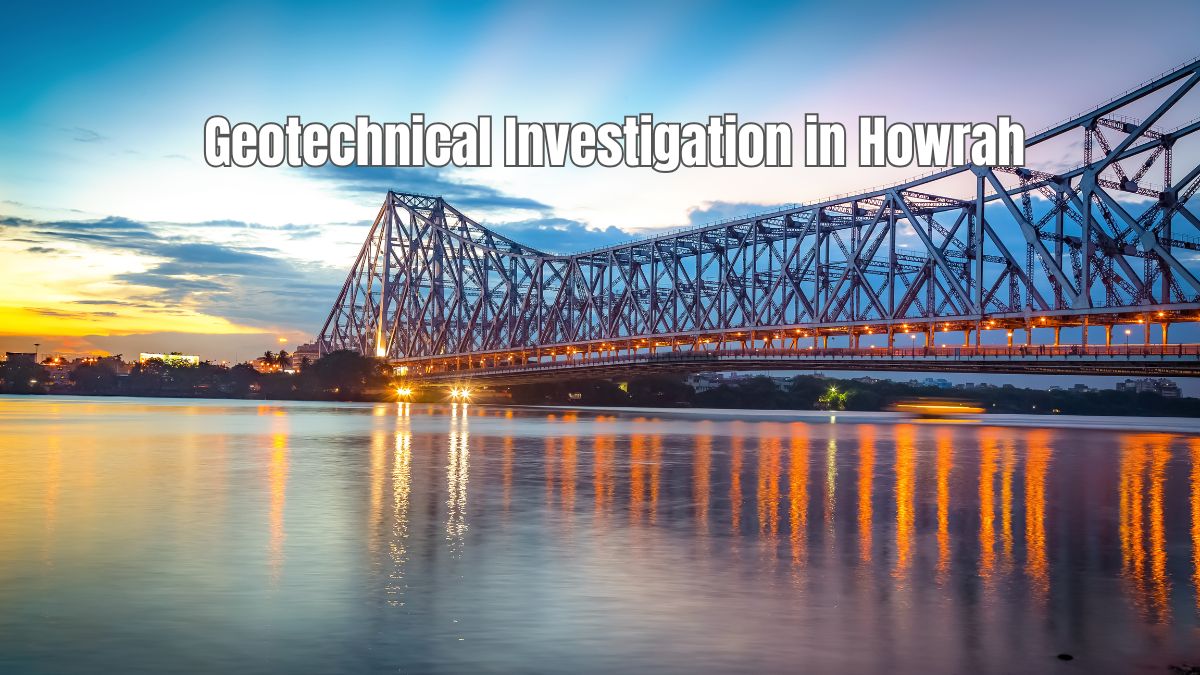
Advanced Geotechnical Investigation and Subsurface Exploration in Howrah, West Bengal: A Guide by Dibru Enterprises Overseas
The Essential Role of Subsurface Analysis in Howrah’s Development
Howrah, the massive industrial and transportation nerve center of West Bengal, presents a unique set of engineering challenges. As the gateway to Kolkata and a historic hub for heavy engineering, textile mills, and jute industries, the structural integrity of every building, bridge, and factory in Howrah is dictated by the soil beneath it.
Dibru Enterprises Overseas, headquartered in Guwahati, Assam, brings a specialized suite of Geotechnical Investigation and Geophysical Exploration services to the Howrah region. With a track record of providing expertise across India, we understand that the success of a project is not just in the materials used above ground, but in the scientific understanding of the ground itself.
The Geological Landscape of Howrah: A Deltaic Challenge
Howrah is situated within the lower reaches of the Indo-Gangetic Plain, specifically on the western bank of the Hooghly River. Geologically, this area is a part of the Bengal Basin, characterized by vast thicknesses of quaternary sediments.
For engineers, this means dealing with an Alluvial Plain environment. The soil profile typically consists of alternating layers of clay, silt, and sand. Because these sediments were deposited by river systems over thousands of years, the layers can be highly inconsistent. A firm sandy layer at one depth might be underlain by a soft, highly compressible clay layer just a few meters deeper.
Subsurface Factors Unique to Howrah:
- Soft Clay Deposits: These layers are notorious for long-term “settlement.” If a heavy structure is built without proper investigation, it may slowly sink over decades, leading to structural failure.
- High Groundwater Table: Proximity to the river means the water table is often just a few meters below the surface. This creates “buoyancy” effects and complicates deep excavations.
- Vibrational Sensitivity: Given Howrah’s industrial nature, soil must be tested for its ability to handle machine-induced vibrations, which can cause “soil fatigue” or settlement in sandy layers.
Our Geotechnical Service Offerings in Howrah
Dibru Enterprises Overseas provides a comprehensive range of field and laboratory services tailored to the specific needs of Howrah’s urban and industrial sectors.
1. Field Exploration and In-Situ Testing
We utilize modern equipment to extract data directly from the ground at your site.
- Borehole Drilling: Using rotary and percussive drilling to reach significant depths to identify the best founding strata.
- Standard Penetration Test (SPT): The most widely recognized test in Howrah for determining the relative density of sands and the consistency of clays.
- Cone Penetration Testing (CPT): Providing a continuous record of soil resistance, which is invaluable for identifying thin, weak soil layers that might be missed by standard drilling.
- Vane Shear Tests: Specifically used in the soft clay deposits of the Hooghly banks to measure the undrained shear strength of the soil.
2. Geophysical Exploration (Non-Invasive Methods)
In a densely built city like Howrah, it is not always possible to drill everywhere. Our geophysical methods provide a broader view of the subsurface without disturbing existing structures.
- Electrical Resistivity Tomography (ERT): By passing electrical currents through the ground, we map the variation in soil types and groundwater distribution.
- Ground Penetrating Radar (GPR): Essential for detecting buried utilities, old foundation remnants, or voids in the older industrial sectors of Howrah.
- Seismic Refraction: Helps in determining the dynamic properties of the soil, which is critical for seismic-resistant design in West Bengal’s earthquake zones.
Comparing Terrains: Why One Method Does Not Fit All
As an exploration firm with a pan-India presence, Dibru Enterprises Overseas adapts its methodology based on the geographical situation of the area. The approach we use in the plains of Howrah is vastly different from what we use in hilly or rocky regions.
The Plain/Alluvial Situation (Example: Howrah, West Bengal)
In plain areas like Howrah, the primary goal is to find a layer that can support the vertical load of a building without excessive sinking.
- Key Challenge: Soft soil consolidation and liquefaction risk.
- Primary Tool: Deep boring and consolidation testing.
- Foundation Strategy: Often requires deep pile foundations that go 20 to 40 meters deep to find stable sand or stiff clay.
The Hilly Situation (Example: Assam and North Bengal)
In the hilly terrains where we are based, the challenges are lateral rather than vertical.
- Key Challenge: Slope stability, landslides, and weathered rock layers.
- Primary Tool: Rock core drilling and inclinometer installation to monitor ground movement.
- Foundation Strategy: Step foundations or rock anchors to secure the structure against gravity and rainfall-induced shifts.
The Rocky Situation (Example: Western West Bengal and Plateau regions)
In rocky areas, the soil is thin, and the bedrock is close to the surface.
- Key Challenge: Difficulty of excavation and identifying fractures in the rock.
- Primary Tool: Diamond core drilling and Rock Quality Designation (RQD) analysis.
- Foundation Strategy: Shallow foundations or “raft” foundations are often sufficient, provided the rock is not heavily fractured.
The Importance of Laboratory Testing
Field data is only half of the story. Samples collected from Howrah are sent to our specialized labs to determine the “engineering parameters” required for design.
- Atterberg Limits: These tests tell us how much water the clay can hold before it turns into a liquid or a plastic state. This is vital for predicting how the soil will behave during Howrah’s heavy monsoon seasons.
- Grain Size Distribution: Knowing the percentage of sand, silt, and clay helps in calculating the permeability and the risk of “piping” or soil erosion under foundations.
- Triaxial Strength Tests: We simulate the pressure of a building on the soil sample to see exactly when it will fail. This provides the “Factor of Safety” for the project.
- Chemical Analysis: We test soil and groundwater for pH, sulfates, and chlorides. In industrial areas like Howrah, chemical runoff can often make groundwater acidic, which can eat away at concrete foundations over time.
Serving Howrah’s Diverse Infrastructure
Dibru Enterprises Overseas caters to various sectors within the Howrah district:
- Urban Infrastructure: High-rise residential apartments near the Foreshore Road and Santragachi area.
- Industrial Sheds: Foundations for heavy manufacturing units in Jalan Industrial Complex and Dhulagarh.
- Transport and Logistics: Warehousing hubs that require high-strength flooring and pavement design.
- Public Works: Bridges, flyovers, and water treatment plants that demand the highest level of geotechnical accuracy.
Why Choose Dibru Enterprises Overseas?
Based in Guwahati but serving all of India, our firm offers a unique perspective on Indian geology.
- Expertise Across Terrains: Our experience in the challenging hills of the Northeast translates into a meticulous attention to detail when working in the plains of West Bengal.
- Scientific Precision: We do not rely on “rules of thumb.” Every recommendation we provide for a site in Howrah is backed by rigorous testing and IS (Indian Standard) code compliance.
- Integrated Solutions: By offering both Geotechnical and Geophysical services, we provide a more holistic view of the site than firms that only do drilling.
- Logistical Flexibility: We are equipped to mobilize our rigs and teams to any part of Howrah, from the congested lanes of the city to the expansive industrial zones on the outskirts.
The Lifecycle of a Geotechnical Project
When you engage Dibru Enterprises Overseas for a project in Howrah, the process follows a clear path:
- Site Reconnaissance: Our team visits the site to understand the topography and accessibility.
- Field Mobilization: Drilling rigs and testing equipment are brought to the site.
- Data Collection: Boreholes are made, and tests like SPT are performed at regular intervals (usually every 1.5 to 3 meters).
- Lab Phase: Samples are carefully sealed and transported to the laboratory.
- Engineering Analysis: Our geotechnical engineers calculate the Safe Bearing Capacity (SBC) and recommend foundation types.
- Reporting: You receive a comprehensive report that serves as the “bible” for your structural engineer.
Contact Information
For professional, reliable, and technically sound geotechnical investigation services in Howrah and throughout West Bengal, contact the experts at Dibru Enterprises Overseas.
- Phone: +91 93952 64997
- Email:ent@gmail.com
- Website: https://dibruenterprises.com/
- Headquarters: Guwahati, Assam (Services available Pan-India)
Conclusion: Building a Safer Howrah
Howrah is a city built on history, but its future depends on modern engineering. The alluvial soil of the Hooghly basin is a living, changing entity that requires respect and scientific understanding. By investing in a high-quality geotechnical investigation, you are not just fulfilling a regulatory requirement—you are ensuring the safety of lives and the longevity of your investment.
Dibru Enterprises Overseas is committed to providing the subsurface clarity you need to build with confidence in Howrah and beyond.
Related Posts
This Post Has 0 Comments