
Soil Testing Geotech Services in Gorakhpur, Uttar Pradesh by Dibru Enterprises Overseas Modern construction projects…
Soil Testing Geotech Services in Prayagraj, Uttar Pradesh
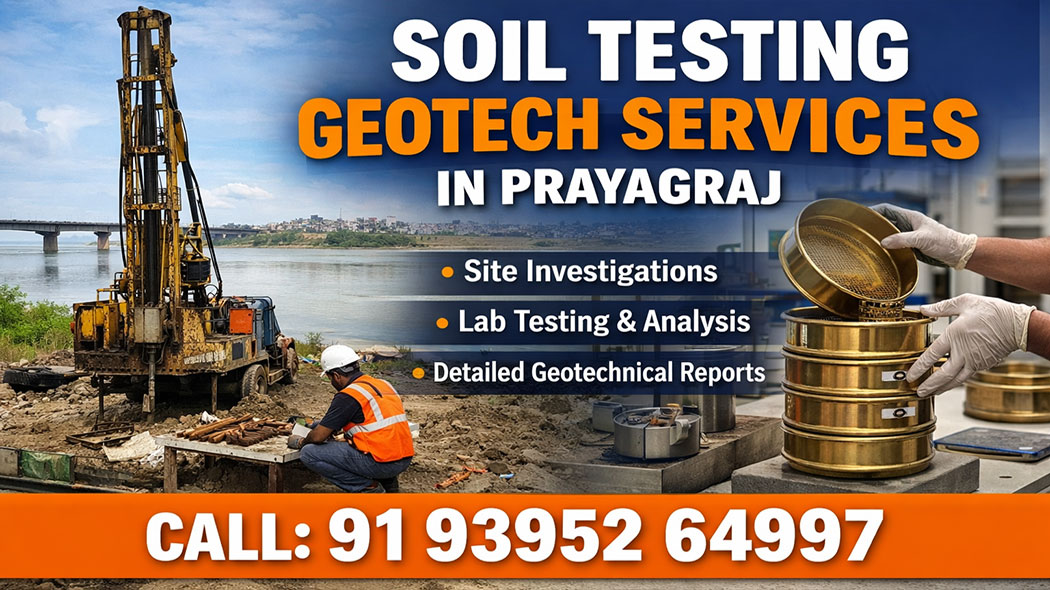
Soil Testing Geotech Services in Prayagraj, Uttar Pradesh
Infrastructure development depends heavily on understanding the ground beneath every structure. Soil conditions influence the safety, durability, and cost of construction projects. Professional Soil Testing Geotech Services therefore play a crucial role in planning and executing any engineering project. Dibru Enterprises Overseas, based in Guwahati, Assam, provides comprehensive soil testing and geotechnical investigation services in Prayagraj, Uttar Pradesh and across India.
Prayagraj, formerly known as Allahabad, is one of the most important urban centers in Uttar Pradesh. The city lies at the confluence of the Ganga, Yamuna, and the mythical Saraswati rivers. This geographic setting creates unique soil conditions that require detailed geotechnical assessment before any construction activity begins. Whether the project involves residential complexes, commercial buildings, bridges, highways, or industrial facilities, soil testing becomes essential to ensure structural stability.
Dibru Enterprises Overseas offers advanced soil investigation solutions tailored to the geological conditions of Prayagraj. The company utilizes modern equipment, experienced engineers, and precise testing methods to provide reliable geotechnical reports that support safe construction.
Understanding Soil Conditions in Prayagraj
Prayagraj sits within the Indo-Gangetic Plain, which consists largely of alluvial soil deposits. Over centuries, rivers have deposited layers of sand, silt, and clay across the region. These sediments influence soil behavior and engineering properties.
Construction projects in Prayagraj must consider several soil-related factors:
- Presence of soft alluvial deposits
- Variable soil density across different locations
- Fluctuating groundwater levels due to river proximity
- Potential for settlement in loose soil layers
Riverine plains often contain stratified soil layers with varying strength. A strong layer at one depth may suddenly change into weaker clay or loose sand. Such variations make geotechnical investigation extremely important.
Soil testing helps engineers identify these layers and determine the most suitable foundation design. Without proper soil analysis, structures may suffer from settlement, cracks, or even structural failure.
About Dibru Enterprises Overseas
Dibru Enterprises Overseas is a professional service provider specializing in soil testing and geotechnical engineering services. Though headquartered in Guwahati, Assam, the company offers its services throughout India, including Prayagraj and other cities in Uttar Pradesh.
The organization focuses on delivering accurate soil investigation data that supports safe infrastructure development. Engineers at Dibru Enterprises Overseas follow established testing standards and industry protocols to ensure reliable results.
Contact Details
Dibru Enterprises Overseas
Guwahati, Assam
Phone: 91 93952 64997
Email: dibru.ent@gmail.com
Website: https://dibruenterprises.com/
The company supports a wide range of projects including residential developments, commercial complexes, highways, bridges, railways, industrial plants, and infrastructure projects.
What Are Soil Testing Geotech Services?
Soil Testing Geotech Services refer to technical procedures used to evaluate the physical, mechanical, and chemical properties of soil and subsurface materials. These investigations provide essential information for civil engineering and construction projects.
Geotechnical analysis ensures that the ground can safely support structures such as buildings, roads, dams, and bridges.
Key objectives of soil testing include:
Assess Soil Strength and Stability
Engineers must determine how soil behaves under structural loads. Testing identifies whether the soil can support foundations without excessive settlement.
Characterize Soil Composition
Laboratory analysis determines grain size distribution, moisture content, plasticity, and density. These characteristics influence soil performance under stress.
Determine Groundwater Conditions
Groundwater level affects excavation methods, drainage planning, and foundation design. In riverine cities like Prayagraj, groundwater investigation becomes particularly important.
Support Engineering Design
Structural engineers rely on soil data to select the correct foundation type. Shallow foundations, pile foundations, raft foundations, or deep foundations may be recommended based on soil strength.
Importance of Soil Testing Before Construction
Soil investigation provides critical data that helps engineers design safe and economical structures. Ignoring soil conditions can lead to costly failures.
Prevent Structural Damage
Weak soil layers may compress under load. Settlement can cause cracks in walls, uneven floors, and foundation damage.
Improve Safety
Geotechnical testing reduces the risk of structural collapse. Engineers gain a clear understanding of the ground’s load-bearing capacity.
Optimize Construction Costs
Accurate soil information prevents unnecessary over-design. At the same time, it avoids under-design that could compromise safety.
Ensure Regulatory Compliance
Many building codes and government regulations require certified geotechnical investigation reports before construction begins.
Soil Testing and Geotechnical Investigation Services Offered
Dibru Enterprises Overseas provides a comprehensive range of soil testing services in Prayagraj.
Soil Sampling and Field Investigation
Field investigation begins with drilling boreholes and collecting soil samples from different depths. Engineers analyze these samples to understand subsurface conditions.
Field activities typically include:
- Borehole drilling
- Disturbed and undisturbed sampling
- Groundwater observation
- Soil layer identification
These procedures help determine the vertical profile of soil layers.
Standard Penetration Test (SPT)
The Standard Penetration Test is one of the most widely used field tests in geotechnical engineering. Engineers drive a sampler into the soil using a standard hammer.
The number of blows required to penetrate a certain depth indicates soil strength and density.
SPT results help estimate:
- Soil bearing capacity
- Relative density of sand
- Consistency of clay layers
This information supports foundation design decisions.
Cone Penetration Test (CPT)
The Cone Penetration Test provides continuous soil resistance data with depth. A cone-shaped probe is pushed into the ground using hydraulic equipment.
Measurements include:
- Cone resistance
- Sleeve friction
- Pore water pressure
CPT helps identify soil stratification and provides detailed geotechnical profiles.
Plate Load Test
The Plate Load Test determines the load-bearing capacity of soil directly in the field. Engineers place a steel plate on the ground and apply incremental loads.
Measurements of settlement under load help evaluate foundation performance.
This test proves especially useful for shallow foundation design.
Laboratory Testing of Soil Samples
Laboratory testing provides precise measurements of soil properties. Samples collected from the field undergo several analytical procedures.
Grain Size Analysis
Grain size distribution determines whether soil contains sand, silt, or clay particles. Engineers use sieve analysis and hydrometer testing for this purpose.
Particle distribution influences drainage, compaction, and stability.
Atterberg Limits Test
Atterberg limits define the plasticity characteristics of fine-grained soils. These limits include:
- Liquid Limit
- Plastic Limit
- Plasticity Index
Plastic soils behave differently from sandy soils under moisture changes. Understanding plasticity helps engineers predict soil behavior.
Moisture Content and Density Tests
Moisture content affects soil strength and compaction. Laboratory analysis determines the natural water content of soil samples.
Compaction tests identify the optimal moisture level required for maximum soil density.
These tests are important for road construction and embankment projects.
Shear Strength Testing
Shear strength defines how soil resists sliding along internal surfaces. Engineers evaluate shear strength using tests such as:
- Direct Shear Test
- Triaxial Compression Test
Results help analyze slope stability and foundation safety.
Geotechnical Reporting and Engineering Recommendations
Once field and laboratory investigations are completed, engineers compile the results into a detailed geotechnical report.
A typical geotechnical report includes:
- Soil stratification profile
- Engineering properties of soil layers
- Groundwater conditions
- Bearing capacity calculations
- Settlement analysis
- Recommended foundation types
The report also provides guidance on excavation methods, compaction techniques, and drainage systems.
Construction engineers use this information to design safe and efficient structures.
Applications of Soil Testing in Prayagraj
Soil testing plays an essential role in various development projects across Prayagraj.
Residential and Commercial Construction
Apartment complexes, houses, and office buildings require accurate soil investigation before foundation design.
Geotechnical analysis helps prevent structural damage caused by soil settlement.
Roads and Highways
Road infrastructure requires strong and stable subgrade soil. Soil testing helps engineers design durable pavements that resist deformation.
Compaction tests and strength analysis support highway construction.
Bridges and Riverfront Structures
Prayagraj’s proximity to major rivers increases the importance of soil investigation for bridge foundations.
Engineers must evaluate riverbed soil properties and potential scour risks.
Industrial and Infrastructure Projects
Factories, warehouses, and power plants impose heavy loads on the ground. Geotechnical services ensure that foundations can support these loads safely.
Challenges of Soil Conditions in River Basin Cities
Cities located near rivers often face unique geotechnical challenges.
Soft Alluvial Soil
Deposits of silt and clay can create soft soil layers with low strength.
High Groundwater Levels
Water table fluctuations may affect excavation and foundation stability.
Soil Liquefaction Risk
Loose sandy soils saturated with water can lose strength during earthquakes.
Professional soil investigation identifies these risks early and provides engineering solutions.
Why Choose Dibru Enterprises Overseas for Soil Testing in Prayagraj
Dibru Enterprises Overseas brings expertise, experience, and advanced equipment to every project.
Key advantages include:
Experienced Geotechnical Engineers
The team possesses strong technical knowledge and field experience in soil investigation.
Modern Testing Equipment
Advanced tools ensure accurate soil sampling and laboratory analysis.
Reliable Geotechnical Reports
Detailed reports support engineering design and regulatory compliance.
Nationwide Service Coverage
Although based in Guwahati, the company provides services across India, including Uttar Pradesh.
Customized Investigation Plans
Each project receives a tailored soil testing approach depending on site conditions and construction requirements.
The Role of Soil Testing in Sustainable Development
Urban expansion and infrastructure development continue to grow in cities like Prayagraj. Responsible development requires careful evaluation of natural ground conditions.
Soil testing helps minimize environmental impact and improves construction sustainability.
Accurate soil data allows engineers to design foundations that reduce material waste and construction costs. Proper ground analysis also prevents long-term structural problems that may require expensive repairs.
Reliable geotechnical investigation therefore contributes to safer and more sustainable infrastructure.
Conclusion
Soil Testing Geotech Services form the backbone of safe and efficient construction projects. In a city like Prayagraj, where river deposits create complex soil conditions, professional soil investigation becomes even more important.
Dibru Enterprises Overseas provides reliable soil testing and geotechnical services to support construction projects throughout Prayagraj and across India. Using advanced equipment, skilled engineers, and thorough laboratory analysis, the company delivers accurate geotechnical data that helps engineers design stable foundations.
Developers, builders, infrastructure planners, and engineering firms can benefit from professional soil investigation before starting any construction activity.
For dependable soil testing services in Prayagraj, contact Dibru Enterprises Overseas today.
Phone: 91 93952 64997
Email: dibru.ent@gmail.com
Website: https://dibruenterprises.com/
Proper soil investigation ensures strong foundations, safer structures, and long-lasting infrastructure.
Related Posts


This Post Has 0 Comments