
Earth Resistivity Test and Electrical Resistivity Tomography (ERT) for Earth Mat Design in Roing, Arunachal…
Earth Resistivity Test | Tomography (ERT) for Earth Mat Design in Pasighat
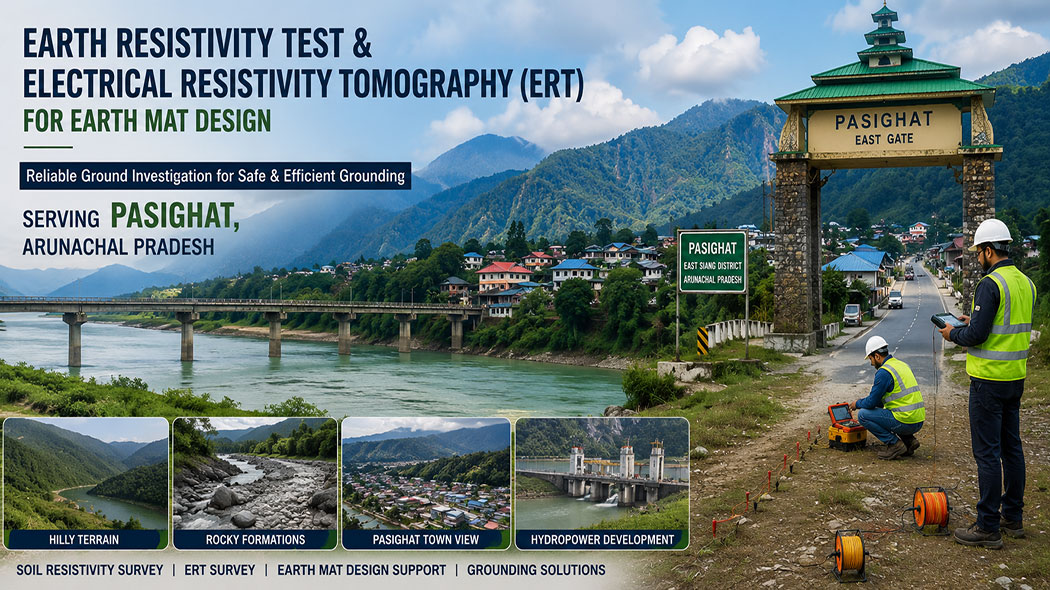
Earth Resistivity Test and Electrical Resistivity Tomography (ERT) for Earth Mat Design in Pasighat, Arunachal Pradesh
Modern electrical infrastructure depends heavily on safe and efficient grounding systems. Industries, substations, transmission lines, hydropower projects, telecom towers, commercial buildings, and renewable energy plants require properly designed earthing systems to ensure electrical safety and equipment protection. One of the most critical steps before designing an earth mat is conducting a detailed Earth Resistivity Test and Electrical Resistivity Tomography (ERT) survey.
In Pasighat, Arunachal Pradesh, ground conditions vary significantly due to changing terrain, riverine deposits, rocky formations, high rainfall, and hilly landscapes. These factors directly affect soil resistivity and grounding performance. A scientific resistivity investigation helps engineers design effective earthing systems suitable for local geological conditions.
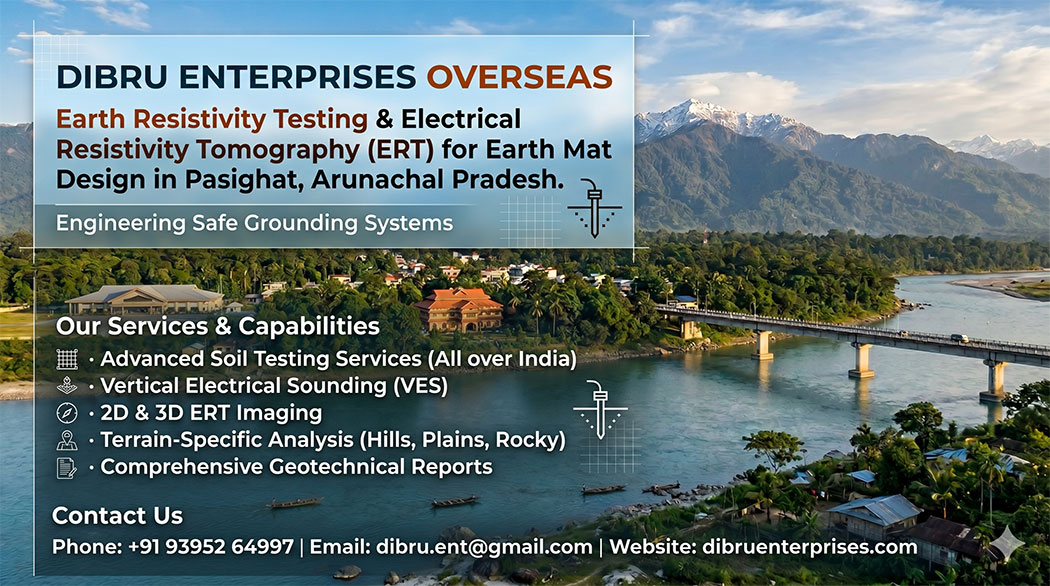
Dibru Enterprises Overseas, based in Guwahati, Assam, provides professional Earth Resistivity Test and Electrical Resistivity Tomography (ERT) services in Pasighat and across Arunachal Pradesh. The company specializes in soil testing and geophysical investigation services throughout India.
Website: Dibru Enterprises Overseas
Phone: +91 93952 64997
Email: dibru.ent@gmail.com
Understanding Earth Resistivity Testing
Earth resistivity testing measures how strongly the soil resists the flow of electrical current. The test helps determine the suitability of the ground for earthing and grounding systems.
Electrical substations, industrial plants, telecom infrastructure, and power transmission facilities rely on low-resistance grounding systems for safety. Poor grounding can lead to equipment damage, electrical hazards, shock risks, and operational failures.
Engineers use resistivity data to design:
- Earth mats
- Earthing grids
- Ground rods
- Lightning protection systems
- Neutral grounding systems
- Substation grounding networks
Ground resistivity differs from one location to another. Even within a small project site, the resistivity may vary due to soil composition, moisture content, rock presence, groundwater conditions, and seasonal rainfall.
Importance of Earth Mat Design in Pasighat
Pasighat is one of the important urban and infrastructural regions in Arunachal Pradesh. The area experiences heavy monsoon rainfall and diverse geological conditions. Certain locations contain alluvial soil near river belts, while nearby areas may contain hard rock or compact formations.
These variations create challenges for earthing system design.
A standard grounding design without field testing may fail under actual site conditions. Proper Earth Resistivity Testing and ERT surveys help identify:
- Depth-wise resistivity variations
- Moisture-rich conductive layers
- Hard rock formations
- Subsurface fractures
- Weathered zones
- Groundwater-bearing strata
- Soil stratification
This information allows engineers to optimize the earth mat layout and improve grounding efficiency.
What is Electrical Resistivity Tomography (ERT)?
Electrical Resistivity Tomography, commonly known as ERT, is an advanced geophysical survey method used to image subsurface resistivity distribution.
Unlike conventional point-based resistivity testing, ERT provides a detailed two-dimensional or three-dimensional view of underground conditions.
The survey involves placing multiple electrodes on the ground surface. Controlled electrical current passes through the subsurface while measurements are recorded systematically. Advanced software then processes the data to generate resistivity profiles.
ERT helps identify:
- Subsurface geological layers
- Moisture distribution
- Rock depth
- Fracture zones
- Weak zones
- Conductive formations
- Groundwater zones
For earth mat design, ERT provides highly reliable information regarding the best depth and area for grounding installations.
Why ERT is Important for Earth Mat Design
Traditional grounding designs sometimes rely only on surface-level resistivity measurements. However, soil conditions often change significantly with depth.
ERT provides detailed subsurface information that helps engineers:
Identify Low Resistivity Zones
Low resistivity layers conduct electricity more efficiently. Engineers can utilize these zones for better grounding performance.
Detect Rocky Formations
Rocky terrain increases grounding resistance. ERT helps determine rock depth and extent before installation begins.
Optimize Earth Electrode Placement
Proper electrode positioning improves grounding efficiency and reduces project cost.
Improve Safety Standards
Accurate data reduces electrical hazards and ensures compliance with engineering standards.
Reduce Long-Term Maintenance
Properly designed earthing systems perform better during seasonal changes and require less maintenance.
Ground Conditions in Pasighat and Their Impact on Resistivity
Pasighat and nearby regions of Arunachal Pradesh exhibit mixed geological conditions. Ground resistivity depends greatly on terrain type.
Riverine and Alluvial Areas
Certain parts near river plains contain moisture-rich alluvial soil. These areas usually show lower resistivity values. Grounding systems in such locations often perform efficiently.
However, seasonal flooding and water table fluctuations may affect long-term stability. Engineers must design earthing systems carefully to withstand changing conditions.
Hilly Terrain
Several nearby areas contain slopes and uneven terrain. Soil depth may remain shallow in elevated regions. Hard rock may appear at lower depths.
Such conditions increase resistivity and complicate earth mat installation.
Rocky Zones
Rock formations reduce electrical conductivity significantly. In these areas, conventional earthing methods may fail to achieve desired grounding resistance.
ERT surveys help identify fractures or weathered rock zones that can improve grounding performance.
High Rainfall Influence
Arunachal Pradesh receives substantial rainfall throughout the year. Moisture generally lowers soil resistivity temporarily.
However, resistivity values may rise during dry periods. Therefore, seasonal variations must be considered during earth mat design.
Applications of Earth Resistivity Testing and ERT
Dibru Enterprises Overseas provides resistivity investigation services for multiple sectors.
Electrical Substations
Grounding systems protect substations from fault currents and lightning surges. Accurate resistivity data ensures reliable protection.
Hydropower Projects
Arunachal Pradesh hosts several hydropower developments. Earthing design remains essential for turbine systems, transformers, switchyards, and control rooms.
Transmission Line Projects
Transmission towers require proper grounding for operational safety and lightning protection.
Solar Power Plants
Renewable energy projects require scientifically designed grounding systems for long-term performance.
Telecom Infrastructure
Telecommunication towers require low-resistance grounding systems to protect sensitive electronic equipment.
Industrial Plants
Factories and processing facilities depend on safe grounding networks for personnel and equipment safety.
Oil and Gas Installations
Grounding prevents electrical hazards in hazardous industrial environments.
Methods Used in Earth Resistivity Surveys
Professional resistivity surveys involve standardized testing procedures.
Wenner Four Pin Method
This is one of the most widely used techniques for soil resistivity measurement.
Four electrodes are placed in a straight line with equal spacing. Electrical current passes through the outer electrodes while voltage is measured through the inner electrodes.
The method helps determine average soil resistivity at different depths.
Schlumberger Method
This method uses wider electrode spacing and provides deeper subsurface information.
It is useful for geological investigations and groundwater studies.
Multi-Electrode ERT Survey
Advanced ERT systems use automated switching between multiple electrodes to generate detailed subsurface images.
The technique offers higher accuracy and improved interpretation capability.
Equipment Used for ERT and Resistivity Testing
Dibru Enterprises Overseas utilizes modern geophysical instruments for reliable data acquisition.
Common equipment includes:
- Digital resistivity meters
- Multi-electrode imaging systems
- GPS positioning systems
- Data loggers
- Ground resistance meters
- Geophysical processing software
Advanced equipment improves data quality and interpretation accuracy.
Process Followed During Earth Resistivity Testing
Site Reconnaissance
The team first studies the project location and identifies terrain conditions, accessibility, and testing requirements.
Electrode Layout
Survey electrodes are installed according to the required testing configuration.
Field Data Collection
Electrical measurements are collected systematically across the survey area.
Data Processing
Specialized software processes raw field data into resistivity profiles and subsurface models.
Interpretation
Experienced geophysicists analyze the results and identify suitable grounding zones.
Reporting
A detailed technical report is prepared for engineering and design purposes.
Benefits of Professional Resistivity Surveys
Improved Grounding Efficiency
Scientific analysis helps achieve lower grounding resistance values.
Cost Optimization
Proper design minimizes unnecessary excavation and material usage.
Better Safety
Accurate grounding systems reduce electrical shock and fault risks.
Long-Term Reliability
Well-designed earth mats perform consistently under changing environmental conditions.
Faster Project Execution
Reliable data reduces engineering uncertainties during construction.
Why Choose Dibru Enterprises Overseas
Dibru Enterprises Overseas is a trusted service provider for soil testing and geophysical investigations across India.
The company offers specialized services in:
- Earth Resistivity Testing
- Electrical Resistivity Tomography (ERT)
- Soil Investigation
- Geotechnical Surveys
- Groundwater Investigation
- Borehole Planning
- Soil Bearing Capacity Testing
- Geological Surveys
Experienced Technical Team
The company employs skilled professionals experienced in challenging terrain conditions across Northeast India.
Modern Survey Equipment
Advanced instruments ensure accurate field measurements and dependable results.
Services Across Difficult Terrain
The team conducts surveys in plains, hills, rocky terrain, river valleys, and remote project areas.
Customized Engineering Support
Every project receives site-specific analysis and technical recommendations.
Pan India Service Coverage
Although based in Guwahati, the company provides services throughout India.
Challenges of Resistivity Surveys in Arunachal Pradesh
Field investigations in Arunachal Pradesh often involve logistical and geological complexities.
Difficult Accessibility
Remote locations may require transportation through rough terrain and narrow hill roads.
Variable Geology
Geological conditions may change within short distances.
Weather Conditions
Heavy rainfall may affect survey scheduling and field movement.
Dense Vegetation
Forest-covered regions require careful survey planning.
Despite these challenges, professional geophysical surveys remain essential for infrastructure safety and project success.
Importance of Grounding for Electrical Safety
Earthing systems protect both people and equipment.
Proper grounding helps:
- Dissipate fault current safely
- Prevent electrical shock
- Reduce fire risk
- Protect transformers and switchgear
- Improve lightning protection
- Stabilize electrical systems
Without proper resistivity testing, grounding systems may become inefficient and unsafe.
Industries Benefiting from ERT Services in Pasighat
Several sectors in Pasighat and Arunachal Pradesh require resistivity investigation services.
Power Sector
Substations, hydropower stations, and electrical utilities depend heavily on grounding analysis.
Infrastructure Development
Road, bridge, airport, and railway projects require geotechnical and geophysical investigations.
Renewable Energy
Solar and hybrid energy projects require grounding studies before installation.
Construction Industry
Large buildings and industrial structures require proper earthing systems.
Government Projects
Public infrastructure projects often include grounding and safety requirements.
Future Scope of ERT in Northeast India
Infrastructure growth across Northeast India continues to increase the demand for geophysical surveys.
Upcoming developments include:
- Hydropower expansion
- Smart grid systems
- Transmission corridors
- Renewable energy projects
- Telecom network expansion
- Industrial development
ERT and earth resistivity testing will play an important role in supporting these developments safely and efficiently.
Contact Dibru Enterprises Overseas
For professional Earth Resistivity Test and Electrical Resistivity Tomography (ERT) services for Earth Mat Design in Pasighat, Arunachal Pradesh, contact Dibru Enterprises Overseas.
Based in Guwahati, Assam, the company provides reliable soil testing and geophysical survey services across India.
Website: https://dibruenterprises.com/
Phone: +91 93952 64997
Email: dibru.ent@gmail.com
Whether the project involves substations, industrial facilities, hydropower plants, transmission infrastructure, or renewable energy systems, professional resistivity surveys help ensure safer and more efficient grounding design.
Related Posts
This Post Has 0 Comments