
Earth Resistivity Test and Electrical Resistivity Tomography (ERT) for Earth Mat Design in Roing, Arunachal…
Earth Resistivity Test | Tomography (ERT) for Earth Mat Design in Tawang
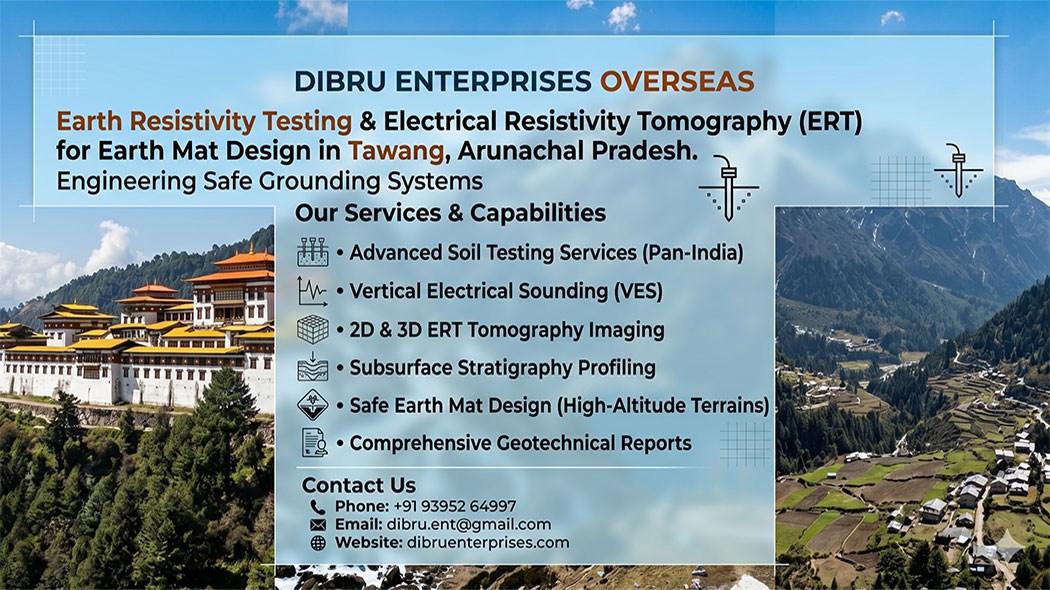
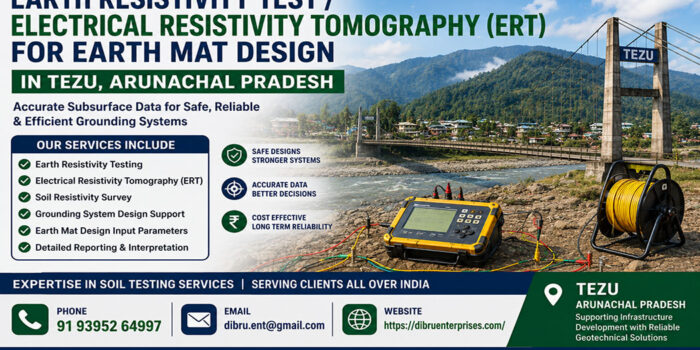
Earth Resistivity Test and Electrical Resistivity Tomography (ERT) for Earth Mat Design in Tawang, Arunachal Pradesh
Electrical grounding systems form the backbone of safe and stable power infrastructure. Every substation, hydropower facility, telecom tower, industrial plant, solar installation, and institutional building requires a properly engineered earthing system to ensure operational safety and equipment protection. One of the most important steps before designing an earth mat is conducting a detailed Earth Resistivity Test and Electrical Resistivity Tomography (ERT) survey.
In Tawang, Arunachal Pradesh, grounding design becomes more challenging due to mountainous terrain, rocky subsurface formations, cold climatic conditions, steep slopes, and varying geological characteristics. Soil conductivity changes significantly across the region, making scientific geophysical investigation essential before executing any grounding project.
Dibru Enterprises Overseas, based in Guwahati, Assam, offers professional Earth Resistivity Testing and Electrical Resistivity Tomography (ERT) services in Tawang and throughout Arunachal Pradesh. The company specializes in advanced soil testing and geophysical investigation services across India.
Website: Dibru Enterprises Overseas
Phone: +91 93952 64997
Email: dibru.ent@gmail.com
Understanding Earth Resistivity Testing
Earth resistivity testing is a scientific method used to measure the resistance of soil against the flow of electrical current. The test helps determine the ability of the ground to safely dissipate electrical fault current.
Grounding systems play a critical role in protecting:
- Electrical equipment
- Transformers
- Switchgear systems
- Transmission infrastructure
- Human life
- Communication systems
Without proper grounding, electrical faults can lead to equipment failure, electrical shock hazards, and operational instability.
The resistivity of soil depends on several site-specific factors, including:
- Rock content
- Soil moisture
- Mineral composition
- Groundwater conditions
- Temperature
- Soil density
- Terrain profile
- Seasonal weather variation
Accurate resistivity testing provides engineers with the information required for designing safe and efficient earth mats.
Importance of Earth Mat Design in Tawang
Tawang is located in the high-altitude Himalayan region of Arunachal Pradesh. The area is characterized by steep mountains, rocky landscapes, narrow valleys, and cold climatic conditions. These environmental and geological factors directly influence grounding system performance.
Unlike plain-land regions with uniform soil conditions, Tawang often presents complex subsurface profiles. In many locations, shallow soil layers overlay hard rock formations. Certain areas may also contain weathered rock and fractured zones with variable conductivity.
Such geological variability makes conventional grounding assumptions unreliable.
Proper Earth Resistivity Testing and ERT surveys help engineers:
- Understand subsurface resistivity variation
- Identify conductive zones
- Locate fractured rock formations
- Determine grounding depth
- Optimize electrode placement
- Improve grounding efficiency
- Reduce construction uncertainty
These investigations become especially important for infrastructure projects in remote mountain regions.
What is Electrical Resistivity Tomography (ERT)?
Electrical Resistivity Tomography, commonly known as ERT, is an advanced geophysical imaging technique used to study underground resistivity distribution.
Traditional resistivity testing generally provides point-based measurements. ERT, however, creates detailed subsurface images that show how resistivity changes across depth and distance.
The process involves:
- Placing multiple electrodes on the ground
- Injecting electrical current into the subsurface
- Recording voltage differences
- Processing field data using specialized software
- Generating two-dimensional or three-dimensional resistivity models
ERT surveys help engineers visualize underground geological conditions before construction begins.
Why ERT is Important in Mountainous Regions Like Tawang
Mountain terrain creates highly variable subsurface conditions. Grounding systems designed without proper investigation may fail to achieve required safety standards.
ERT surveys help address several critical challenges.
Identification of Rocky Layers
Rock formations usually exhibit high electrical resistance. ERT helps locate fractures and weathered zones that may provide better conductivity.
Detection of Moisture Zones
Water-bearing layers often show lower resistivity values. These zones improve grounding performance.
Optimization of Earth Electrode Design
Detailed subsurface imaging helps engineers select suitable grounding methods for difficult terrain.
Reduction of Excavation Cost
Knowing the rock depth beforehand prevents unnecessary excavation and drilling expenses.
Improvement in Safety
Scientifically designed grounding systems reduce electrical hazards and improve infrastructure reliability.
Terrain and Geological Conditions in Tawang
Ground conditions in Tawang differ considerably from those found in lowland regions of India.
Rocky Mountain Terrain
Large portions of Tawang contain exposed rock and compact geological formations. Such conditions generally produce high resistivity values.
Grounding systems in these areas may require deeper electrodes or specialized earthing techniques.
Thin Soil Cover
Certain hill slopes contain very shallow soil layers over bedrock. Conventional earthing systems may not function effectively in such locations.
ERT surveys help identify conductive fractures and weathered formations that improve grounding performance.
Snowfall and Cold Weather
Low temperatures can influence soil moisture and conductivity. Seasonal freezing conditions may increase resistivity temporarily.
Grounding systems must therefore be designed to perform effectively throughout the year.
Valley and Moisture-Rich Areas
Some valleys and lower elevations retain higher moisture content. These areas often exhibit lower resistivity values and improved grounding conditions.
Detailed field investigation helps identify the most suitable zones for earthing installation.
Applications of Earth Resistivity Testing and ERT in Tawang
Dibru Enterprises Overseas provides specialized resistivity survey services for various infrastructure sectors.
Hydropower Projects
Arunachal Pradesh has major hydropower development potential. Earthing systems are essential for switchyards, turbines, transformers, and transmission systems.
Electrical Substations
Substations require low-resistance grounding systems to safely dissipate fault currents and lightning surges.
Telecom Infrastructure
Telecommunication towers in mountain regions require effective grounding protection against lightning and electrical disturbances.
Border Infrastructure Projects
Strategic infrastructure projects in remote areas require scientifically designed grounding systems for operational safety.
Renewable Energy Projects
Solar and hybrid energy systems depend on reliable grounding networks for long-term performance.
Government and Institutional Buildings
Hospitals, schools, administrative facilities, and defense-related infrastructure require proper earthing systems.
Common Methods Used in Resistivity Surveys
Professional Earth Resistivity Testing uses standardized methods to ensure reliable data.
Wenner Four Pin Method
This method uses four equally spaced electrodes placed in a straight line.
Electrical current flows through the outer electrodes while voltage measurements are recorded between the inner electrodes.
The technique helps estimate soil resistivity at different depths.
Schlumberger Method
The Schlumberger configuration allows deeper subsurface investigation using wider electrode spacing.
This method is suitable for geological studies and groundwater investigation.
Multi-Electrode ERT Survey
Modern ERT systems use automated multi-electrode arrays connected to digital imaging equipment.
This technique produces highly detailed resistivity profiles suitable for complex terrain analysis.
Equipment Used for ERT and Resistivity Testing
Dibru Enterprises Overseas utilizes advanced geophysical instruments for field investigations.
The equipment commonly used includes:
- Digital resistivity meters
- Multi-electrode imaging systems
- Ground resistance testers
- GPS-based positioning tools
- Data acquisition systems
- Geophysical interpretation software
Advanced technology improves accuracy and reduces interpretation errors.
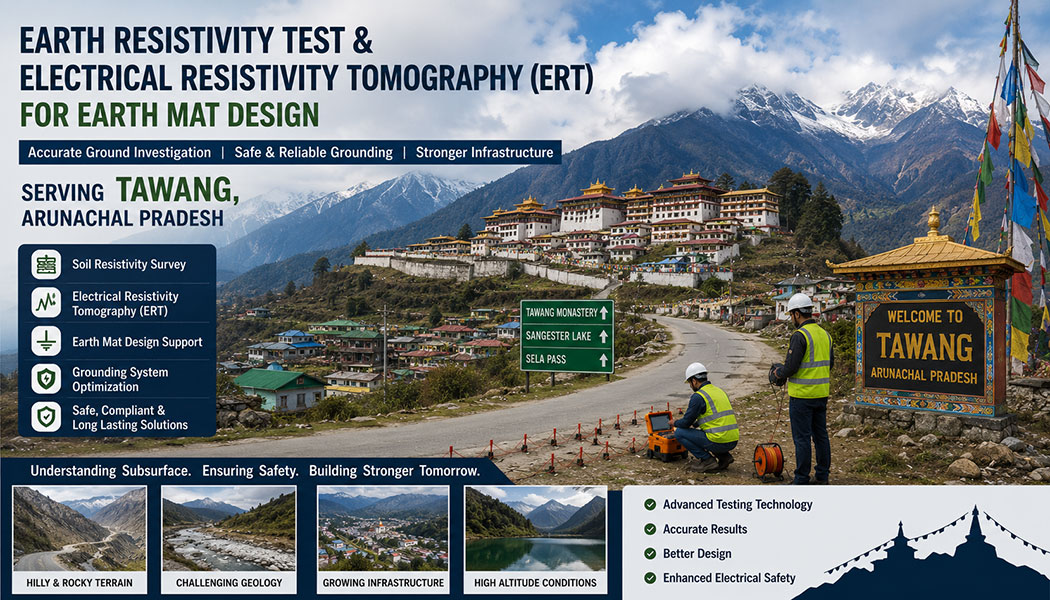
Survey Procedure Followed by Dibru Enterprises Overseas
Preliminary Site Assessment
The technical team evaluates terrain conditions, accessibility, geological characteristics, and project requirements.
Electrode Layout Planning
Electrodes are positioned according to the selected testing method and survey objective.
Field Data Acquisition
Electrical measurements are recorded systematically across the survey area.
Data Processing and Modeling
Specialized software converts raw measurements into subsurface resistivity models.
Interpretation and Analysis
Experienced geophysicists interpret the results and identify suitable grounding zones.
Technical Report Preparation
A detailed report is prepared for engineers, consultants, and project developers.
Benefits of Professional ERT Surveys
Improved Grounding Design
Scientific investigation improves earth mat efficiency and reliability.
Better Project Planning
Subsurface information reduces uncertainty during engineering and construction.
Cost Savings
Accurate data minimizes unnecessary drilling, excavation, and material usage.
Long-Term Reliability
Well-designed grounding systems perform effectively under changing environmental conditions.
Enhanced Electrical Safety
Proper earthing reduces electrical hazards and equipment damage risk.
Challenges of Conducting Surveys in Tawang
Ground investigation work in high-altitude Himalayan terrain involves several operational challenges.
Difficult Accessibility
Remote project locations often require transportation through narrow mountain roads.
Steep Slopes
Survey work on steep terrain requires careful planning and equipment handling.
Extreme Weather
Snowfall, rainfall, fog, and cold temperatures can affect field operations.
Rocky Ground Conditions
Hard rock formations may complicate electrode installation during field surveys.
Despite these challenges, professional geophysical investigation remains essential for safe infrastructure development.
Importance of Grounding Systems for Electrical Safety
Grounding systems protect both equipment and human life.
A properly designed earth mat helps:
- Dissipate fault current safely
- Reduce electrical shock risk
- Protect transformers and switchgear
- Improve lightning protection
- Stabilize electrical systems
- Prevent fire hazards
Without proper resistivity testing, grounding systems may fail during fault conditions.
Why Choose Dibru Enterprises Overseas?
Dibru Enterprises Overseas provides professional soil testing and geophysical investigation services throughout India.
The company offers expertise in:
- Earth Resistivity Testing
- Electrical Resistivity Tomography (ERT)
- Soil Testing Services
- Groundwater Investigation
- Geotechnical Surveys
- Geological Mapping
- Borehole Investigation
- Earth Mat Design Support
Experienced Technical Team
The company has field experience in hilly, rocky, and remote terrain conditions across Northeast India.
Modern Geophysical Equipment
Advanced instruments ensure accurate data collection and reliable interpretation.
Pan India Services
Although headquartered in Guwahati, Assam, the company provides services throughout India.
Customized Technical Solutions
Each project receives location-specific analysis based on actual field conditions.
Detailed Reporting
Comprehensive technical reports support engineering design and project planning.
Growing Demand for ERT Services in Arunachal Pradesh
Infrastructure development in Arunachal Pradesh continues to expand rapidly.
Increasing demand is being driven by:
- Hydropower development
- Transmission line expansion
- Renewable energy projects
- Telecom infrastructure growth
- Institutional construction
- Border area infrastructure projects
Scientific grounding analysis has become essential for ensuring electrical safety and infrastructure reliability in difficult terrain conditions.
Contact Dibru Enterprises Overseas
For professional Earth Resistivity Test and Electrical Resistivity Tomography (ERT) services for Earth Mat Design in Tawang, Arunachal Pradesh, contact Dibru Enterprises Overseas.
The company provides reliable soil testing and geophysical investigation services across India.
Website: https://dibruenterprises.com/
Phone: +91 93952 64997
Email: dibru.ent@gmail.com
Whether the requirement involves substations, hydropower projects, telecom infrastructure, industrial facilities, or renewable energy systems, professional ERT surveys help create safer and more efficient grounding solutions tailored to the unique geological conditions of Tawang and the Himalayan region.
Related Posts
This Post Has 0 Comments