

Soil Testing Geotech Services in Arrah, Bihar Arrah, located in the Bhojpur district of Bihar,…
Soil Testing Geotech Services in Gaya, Bihar
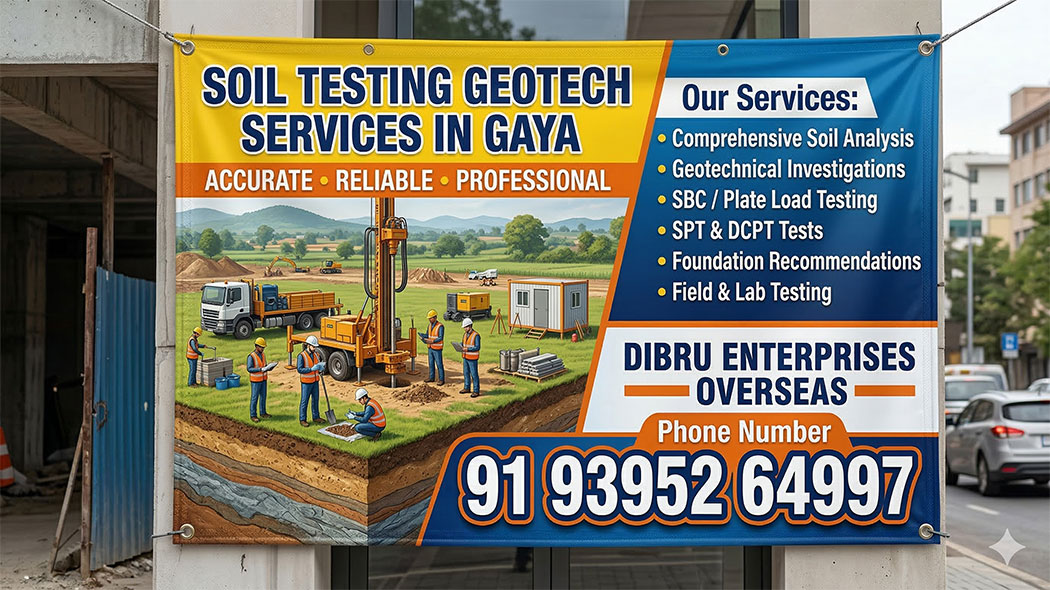
Soil Testing Geotech Services in Gaya, Bihar by Dibru Enterprises Overseas
Rapid urban expansion and infrastructure development in Bihar have increased the need for accurate geotechnical investigations before construction begins. Gaya, one of the most historically and culturally significant cities in Bihar, has experienced continuous growth in residential, commercial, and infrastructure projects. Builders, contractors, engineers, and government agencies working in the region require reliable information about soil conditions to ensure safety and long-term structural performance.
Dibru Enterprises Overseas, based in Guwahati, Assam, provides professional Soil Testing Geotech Services in Gaya, Bihar and across India. The company offers advanced soil investigation, laboratory testing, and geotechnical analysis that help engineers design stable foundations and safe structures.
With modern equipment, experienced professionals, and scientific testing procedures, Dibru Enterprises Overseas supports construction projects of all sizes, including buildings, bridges, highways, industrial facilities, and infrastructure developments.
Phone: 91 93952 64997
Email: dibru.ent@gmail.com
Website: https://dibruenterprises.com/
Understanding the Importance of Soil Testing and Geotechnical Services
Every structure built on land depends on the ground beneath it. Soil conditions vary widely from location to location, even within short distances. Construction without proper soil analysis can lead to settlement problems, structural instability, water seepage, and expensive repairs.
Soil Testing Geotech Services evaluate the physical, mechanical, and chemical properties of soil and subsurface materials. Engineers use these results to determine how the ground will behave when subjected to loads from buildings or infrastructure.
The main goals of geotechnical investigation include:
- Determining soil strength and bearing capacity
- Identifying soil layers and composition
- Understanding groundwater levels
- Providing recommendations for foundation design
- Reducing construction risks
Reliable soil data allows engineers to design foundations that match the ground conditions, ensuring both safety and cost efficiency.
Overview of Gaya’s Geological and Soil Conditions
Gaya lies in the southern region of Bihar and features a combination of plains, rocky terrain, and river-influenced soil formations. The city sits near the Falgu River basin, which contributes to variations in soil composition across different areas.
Several geological characteristics influence construction in Gaya:
Alluvial Soil Zones
Large portions of Gaya consist of alluvial deposits formed by river activity. These soils may contain sand, silt, and clay layers. While some layers provide good bearing capacity, others may compress under load and cause settlement if not properly evaluated.
Rocky and Hard Ground Areas
Certain parts of the district contain rocky outcrops and weathered rock formations. Such terrain may provide strong support for foundations but often requires detailed investigation to determine excavation methods and foundation depth.
Clay and Moisture-Sensitive Soil
Clay-rich soils appear in some locations around Gaya. These soils expand and shrink depending on moisture content, which can influence foundation stability and structural performance.
Groundwater Influence
Seasonal rainfall and river systems affect groundwater levels. Construction projects must consider water table depth, drainage requirements, and potential seepage issues.
Because of these variations, geotechnical investigation becomes essential before starting any major construction project in Gaya.
Dibru Enterprises Overseas – Trusted Soil Testing Experts
Dibru Enterprises Overseas provides comprehensive soil testing and geotechnical investigation services across India. Although the company operates from Guwahati, its professional team conducts field investigations in multiple states, including Bihar.
The company delivers dependable technical analysis that assists civil engineers, architects, developers, and infrastructure planners in making informed design decisions.
Key strengths include:
- Experienced geotechnical professionals
- Modern field testing equipment
- Accurate laboratory testing facilities
- Reliable geotechnical reporting
- Nationwide service coverage
Every project receives careful evaluation to ensure precise data and practical engineering recommendations.
Core Objectives of Soil Testing Geotechnical Services
Assess Soil Strength and Stability
Structures exert load on the ground through their foundations. Soil testing helps engineers determine whether the soil can support the expected load without excessive settlement or failure.
Tests measure soil resistance, density, and compaction characteristics to establish safe bearing capacity.
Characterize Soil Composition
Different soil types behave differently under stress. Laboratory tests identify grain size distribution, clay content, moisture levels, and plasticity. These properties affect drainage, compaction, and structural stability.
Determine Groundwater Conditions
Groundwater influences excavation stability, foundation design, and drainage planning. Soil investigation measures the depth of the water table and evaluates its seasonal variations.
Support Foundation Design
Geotechnical reports provide recommendations for foundation types, including shallow footings, raft foundations, and pile foundations. Proper design prevents structural damage and ensures long-term performance.
Soil Investigation Methods Used in Gaya
Geotechnical investigations combine field tests with laboratory analysis to obtain reliable data about subsurface conditions.
Soil Sampling and Field Testing
Field exploration forms the first stage of geotechnical investigation.
Standard Penetration Test (SPT)
The Standard Penetration Test measures soil resistance during drilling operations. Engineers use SPT values to estimate soil density, strength, and load-bearing capacity.
SPT testing is widely used for building foundations, highway projects, and bridge construction.
Cone Penetration Test (CPT)
The Cone Penetration Test provides continuous soil resistance data as a probe penetrates the ground. This method helps identify soil layers and determine engineering properties.
Plate Load Test
The Plate Load Test evaluates the load-bearing capacity of soil directly at the construction site. Engineers place a steel plate on the ground and gradually apply loads to measure settlement behavior.
This test assists in designing shallow foundations.
Laboratory Soil Testing Procedures
After collecting soil samples from the field, laboratories conduct detailed tests to determine engineering properties.
Grain Size Analysis
This test identifies the distribution of sand, silt, and clay particles within the soil. Grain size influences permeability, compaction, and stability.
Atterberg Limits
Atterberg limit tests measure plasticity and consistency of fine-grained soils. These parameters help engineers classify soil and evaluate its behavior under varying moisture conditions.
Moisture Content and Density Tests
Moisture content significantly affects soil strength. Laboratory tests determine the natural water content and maximum compaction density of soil.
These values guide compaction procedures during construction.
Preparation of Geotechnical Reports
The final stage of soil investigation involves preparing a comprehensive geotechnical report. This document summarizes all findings from field and laboratory tests.
A typical geotechnical report includes:
- Soil stratification and layering
- Engineering properties of soil layers
- Groundwater observations
- Safe bearing capacity recommendations
- Foundation design suggestions
- Excavation and compaction guidelines
Engineers use this report as a reference during structural design and construction planning.
Applications of Soil Testing Geotech Services
Soil investigation plays a critical role in various types of construction and infrastructure projects.
Residential and Commercial Buildings
Building foundations require accurate soil data to prevent settlement or cracking. Geotechnical testing ensures that the ground can support structural loads.
Roads and Highways
Transportation infrastructure relies on stable soil conditions. Soil testing determines the suitability of subgrade soil and helps design pavement layers.
Bridges and Flyovers
Bridge foundations must withstand heavy loads and environmental forces. Geotechnical analysis provides essential data for designing deep foundations such as piles.
Industrial Construction
Factories, warehouses, and manufacturing plants require strong foundations for heavy machinery and structural loads.
Infrastructure Development
Airports, dams, railway lines, and urban infrastructure projects depend on geotechnical investigations for safe and efficient design.
Soil Testing Challenges in Gaya
Geotechnical engineers working in Gaya encounter several challenges due to varying soil and terrain conditions.
Variable Soil Layers
Alluvial deposits often produce alternating layers of sand, silt, and clay. These variations require careful drilling and sampling.
Seasonal Moisture Variation
Monsoon rainfall can significantly influence groundwater levels and soil moisture conditions. Engineers must consider seasonal changes when designing foundations.
Rocky Subsurface in Certain Areas
Rock layers may appear at shallow depths in some regions. Drilling and sampling procedures must adapt to these conditions.
Urban Construction Constraints
Growing urban development sometimes restricts access for drilling rigs and testing equipment. Proper planning ensures safe and efficient investigation.
Dibru Enterprises Overseas uses advanced equipment and experienced personnel to overcome these challenges and deliver reliable results.
Benefits of Professional Soil Testing
Hiring professional geotechnical experts provides several advantages for construction projects.
Improved Structural Safety
Accurate soil analysis ensures that structures remain stable and safe throughout their lifespan.
Reduced Construction Risks
Early identification of weak soil layers or groundwater issues prevents unexpected problems during construction.
Cost Optimization
Reliable soil data helps engineers design efficient foundations. This prevents unnecessary over-design and reduces construction costs.
Compliance with Engineering Standards
Many building regulations require certified soil investigation reports before construction approval.
Nationwide Soil Testing Services by Dibru Enterprises Overseas
Although based in Guwahati, Dibru Enterprises Overseas serves clients across India. The company conducts soil investigation projects in multiple states, supporting infrastructure development nationwide.
Clients include:
- Real estate developers
- Civil engineering contractors
- Government infrastructure agencies
- Industrial project developers
- Architects and consulting engineers
The company delivers reliable geotechnical solutions tailored to each project location and soil condition.
Why Choose Dibru Enterprises Overseas
Choosing the right geotechnical partner ensures accuracy and reliability in soil investigation.
Dibru Enterprises Overseas offers:
Professional field investigation teams
Modern soil testing equipment
Detailed geotechnical reports
Experienced technical consultants
Services across India
Every investigation follows established engineering standards to ensure dependable results.
Contact Dibru Enterprises Overseas
Organizations planning construction projects in Gaya, Bihar can rely on Dibru Enterprises Overseas for accurate and professional Soil Testing Geotech Services.
Phone: 91 93952 64997
Email: dibru.ent@gmail.com
Website: https://dibruenterprises.com/
Early soil investigation helps engineers design safe foundations and avoid costly structural issues. Reliable geotechnical data ensures that construction projects in Gaya proceed with confidence, safety, and long-term stability.
Related Posts



This Post Has 0 Comments